Last updated: August 10, 2026
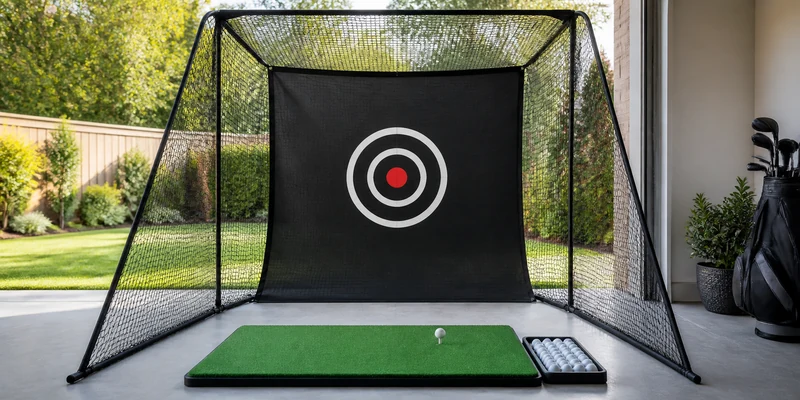
A good golf hitting net is the cheapest way to turn a backyard, garage, or basement into a practice station you actually use. Instead of driving to the range once a week, you can hit a bucket’s worth of balls in the time it takes to brew coffee, with your own clubs, off your own mat, whenever ten free minutes appear.
The catch is that nets vary more than they look. Frame design, netting weight, and how a net absorbs and drops a ball decide whether it survives years of full swings or sags after a season. This guide covers what to check before buying, the nets that come up again and again in owner feedback, and the safety habits that keep full-speed practice boring in the best possible way.
This article contains affiliate links. If you buy through them, we may earn a commission at no extra cost to you. Learn more.
Quick Answer
Which golf hitting net should you buy?
- For most golfers, a freestanding net around 10 feet wide and 7 feet tall from an established brand like GoSports is the sweet spot: enough face area for full swings with room for the occasional off-line shot.
- If you practice indoors or near anything breakable, step up to a net with a top baffle or side barriers, which knock down high and off-line balls a flat net can miss.
- Whatever you buy, plan the space first. A net needs clearance on all sides and a safe direction, because no net catches every mishit.
What to Check Before You Buy
Every row below can be verified from a product listing. Get these right and you will not be shopping for a replacement next spring.
| What to check | Why it matters | What to look for |
|---|---|---|
| Net size | Face area is your margin for error on mishits | Roughly 10 by 7 feet for full swings; smaller only for chipping or tight spaces |
| Netting weight | Thin netting frays and tears under real ball speed | Heavy-duty knotless or multi-ply netting rated for real golf balls, not just foam |
| Frame design | Decides setup time and how the net absorbs impact | Fiberglass poles that flex with impact, or a steel frame where the net hangs loose |
| Ball return | Chasing balls kills practice rhythm | A netting curve or tray that drops balls back toward your feet |
| High-shot protection | Wedges launch steep and can fly over a flat net | A top baffle or extended overhang, especially indoors |
| Anchoring | Outdoor nets act like sails in wind | Ground stakes plus weight bags included or supported |
Before you commit to a spot, read our short guide to golf net safety and space. It covers the clearances, ceiling heights, and aiming rules that make everything else in this article work.
Frame Styles: Flex Poles, Cages, and Pop-Ups
Most hitting nets use one of three designs. Flex-pole nets stretch netting across fiberglass rods that bow under impact and spring back, which absorbs energy well and packs down small. They are the mainstream choice for a reason: quick to assemble, light to move, and durable when the netting is decent quality.
Cage-style nets hang loose netting inside a rigid steel frame, often with side wings. The loose hang is the point: a ball hitting slack netting dies instantly instead of rebounding. Cages suit permanent garage or backyard bays. Pop-up nets, the third style, twist open like a windshield shade. They are fine for chipping and light pitch work, but most are not built for driver speed, so match the net to the swings you plan to make.
Why Netting Quality Beats Net Size
A bigger cheap net fails faster than a smaller good one. Golf balls arrive at highway speeds in a spot the size of a coin, and budget single-ply netting wears exactly where you hit most, right in the middle. Look for knotless polyester netting described as heavy-duty or multi-layered, and for an impact zone that is reinforced or replaceable.
Owner reviews are the honest signal here. Nets that hold up tend to collect comments about years of use; nets that do not tend to collect photos of holes. Brands like GoSports have earned their reputation in exactly this way, with reviews consistently mentioning netting that survives daily full-swing sessions.
Our Top Picks at a Glance
How we chose: we compared widely available hitting nets on netting durability, frame stability, ball return design, and how consistently owners report them standing up to full-speed swings over time. Selections lean on manufacturer specifications and recurring themes in customer reviews rather than any hands-on trial of our own.
One reassurance before the list: every pick here is rated for real golf balls at full swing speed. None of these are chipping-only pop-ups dressed up as driving nets.
🏆 Best Overall
A 10 by 8 foot net with heavy-duty netting and an automatic ball-return system that feeds balls back to your feet. Sets up in minutes and handles everything from wedges to driver.

⭐ Upgrade Pick
A step-up net with an angled top canopy that knocks down steep wedge shots before they clear the net, plus a heavier steel frame. The configuration to buy for garage or indoor practice.

💛 Best Value
A budget-friendly full-size hitting net that covers the essentials, generous face area and stake-down anchoring, for golfers who practice a few times a week rather than daily.

Picks by Situation: Garage, Short Game, and Heavy Use
Beyond the main three, a few situations call for a different shape of net. Each of these has a dedicated guide if the situation matches yours.
🏠 Best for Garages
A compact net sized for a single garage bay, where width and a controlled ball drop matter more than maximum face area. Our full garage golf net guide covers ceiling checks and layout.

🎯 Best for Short Game
A dedicated chipping net with target pockets, the tool that turns ten spare minutes into wedge practice. We compare the options in our chipping net roundup.

🏌️ Best Heavy-Duty Cage
A steel-frame cage with side barriers and loose-hang netting for a permanent bay, the closest thing to a driving range stall at home and a natural base for a simulator build later.

Setting Up: Space, Mat, and What Comes Next
A net alone is half a practice station. Hitting off grass tears up the lawn and hitting off concrete is hard on wrists and clubs, so nearly every net owner adds a proper mat; our hitting mat guide covers the options from budget turf to range-quality. Give the net several feet of clearance behind and beside it, aim it away from windows, cars, and property lines, and anchor it every session if it lives outdoors.
Once the net and mat are in place, the natural next step is knowing where your shots would have gone. A launch monitor reads ball speed, carry, and direction even into a net, which turns blind repetition into actual feedback. Our launch monitor guide ranks the field, and the full outdoor build is covered in our backyard driving range guide.
Common Mistakes to Avoid
- Buying a chipping-grade net for full swings. Pop-up nets are rated for soft shots. Driver speed finds their limits quickly, sometimes on the first session.
- Trusting a flat net indoors. Wedge shots launch steeper than people expect. Indoors or near glass, choose a net with a top baffle or add overhead protection.
- Skipping the anchor step. An unanchored net in wind becomes a kite with poles. Stake it or weight it every time it stands outside.
- Hitting from too close. Netting needs room to flex and decelerate the ball. Follow the listed distance recommendation instead of crowding the net to save space.
- Assuming the net catches everything. A true shank exits at a sharp sideways angle and can miss the net entirely. Position the net so that even your worst miss heads somewhere harmless.
Where to Go From Here
If your net will live indoors, start with the garage setup guide and its ceiling-height checklist. If short game is the priority, the chipping net guide covers smaller, target-focused options. And if you are building toward a full setup, our home practice overview shows how nets, mats, and putting gear fit into a routine that survives real life.
Frequently Asked Questions
Can you use real golf balls with a hitting net? Yes, that is what full-size hitting nets are built for, provided the netting is rated for it and you keep the recommended distance. Foam balls remain the safer choice in tight indoor spaces.
How much space do you need behind and around a net? Plan on clearance behind the net, room to swing freely on all sides, and roughly 9 to 10 feet of ceiling for indoor full swings. Our safety and space guide walks through the exact checks.
Will a hitting net damage my clubs or balls? No more than a range session does. The net absorbs impact gradually; the things that damage clubs are hard floors and thin mats, which is why the mat under you matters as much as the net in front of you.
How long does a golf net last? Quality nets commonly survive years of regular use, with the impact zone wearing first. UV exposure ages outdoor netting, so storing or covering a net between sessions extends its life.
Do I need a mat with my net? Practically, yes. Grass wears bare in a week of daily practice and concrete is unpleasant to hit from. A proper hitting mat completes the station.
The Bottom Line
The best golf hitting net for most golfers is a full-size flex-pole net around 10 by 7 feet with heavy-duty netting, and a top-baffle model if you practice indoors. Buy netting quality over raw size, anchor it outdoors, and set it up with clearance and a safe direction. Pair it with a decent mat and it becomes the most-used piece of golf gear you own.