Last updated: August 10, 2026
A golf net for garage practice is the classic first step toward year-round golf: no weather, no drive to the range, no mowing a bare patch into the lawn. The garage is also the one practice space with a car, a water heater, and drywall inside the miss zone, which is why the setup deserves ten more minutes of thought than a backyard net does.
This guide covers the checks that make garage practice work, ceiling height, swing clearance, and what stands behind and beside the net, plus the nets best suited to a garage bay and the moment when a garage net quietly becomes a golf simulator.
This article contains affiliate links. If you buy through them, we may earn a commission at no extra cost to you. Learn more.
Quick Answer
What do you need for a golf net in the garage?
- Check the ceiling first: most golfers need roughly 9 to 10 feet of clearance for a full swing with a driver, less if you stick to wedges and short irons.
- Choose a net with a top baffle or side barriers for garage use; steep wedge shots and off-line misses are exactly what bare walls and windshields attract.
- Clear the bay completely before every session. A garage net works when nothing you care about shares the room with the ball.
The Garage Checklist Before You Buy Anything
Run through this table with a tape measure before ordering. Five minutes here prevents the two classic outcomes: a net that does not fit, or a swing you cannot finish.
| Check | Target | Notes |
|---|---|---|
| Ceiling height | Roughly 9 to 10 ft for full swings | Measure at your swing spot, not the garage door track; test with a slow-motion swing first |
| Bay depth | Net, ball gap, and stance with room behind you | Follow the net maker’s listed hitting distance; do not crowd the net to fit |
| Width | A single bay minimum | Side clearance for the club at waist height matters more than people expect |
| Behind the net | Nothing fragile within a few feet | Netting flexes backward on impact; give it dead air, not a windshield |
| Overhead | Lights, openers, and tracks out of the ball path | A top baffle helps, cages help more; bare bulbs and steep wedges do not mix |
| Floor | Flat concrete plus a hitting mat | Concrete alone is hard on wrists and clubs; a proper mat is not optional here |
These checks are a condensed version of our full golf net safety and space guide, which also covers aiming rules and what a net can and cannot catch. Worth reading before the first full swing indoors.
Why Garage Nets Have Different Priorities
Outdoors, a missed net shot flies into open space. In a garage, every miss hits something, and the geometry is unforgiving: wedges launch steeply toward the ceiling, thin shots skid low past the base, and a true heel strike exits sideways at an angle no frontal net covers. That is not a reason to skip the garage; it is a reason to buy the right shape of protection.
Practically, that means three upgrades over a bare backyard net: a top baffle or overhang for the steep stuff, side netting or barriers for the sideways stuff, and a disciplined habit of clearing the bay. Foam practice balls are also a legitimate tool for new setups; they let you verify your ball flight pattern indoors before graduating to real balls.
Our Top Picks for Garage Bays
How we chose: we compared widely available nets on footprint, high-shot and side protection, and how consistently owners describe them containing full-speed shots in enclosed spaces. Selections lean on manufacturer specifications and recurring themes in customer reviews rather than any hands-on trial of our own.
All three picks fit a standard garage bay; measure your own before ordering, since door tracks and openers steal more room than expected.
🏆 Best Overall for Garages
A hitting net with an angled top baffle that knocks down steep wedge shots before they reach the ceiling, the single most garage-relevant feature on the market, plus heavy-duty netting for daily use.

💛 Best Value
The standard 10 by 7 foot flex-pole net that fits most single bays and handles full swings, best paired with foam balls or careful aim discipline until you know your miss pattern.

⭐ Upgrade Pick
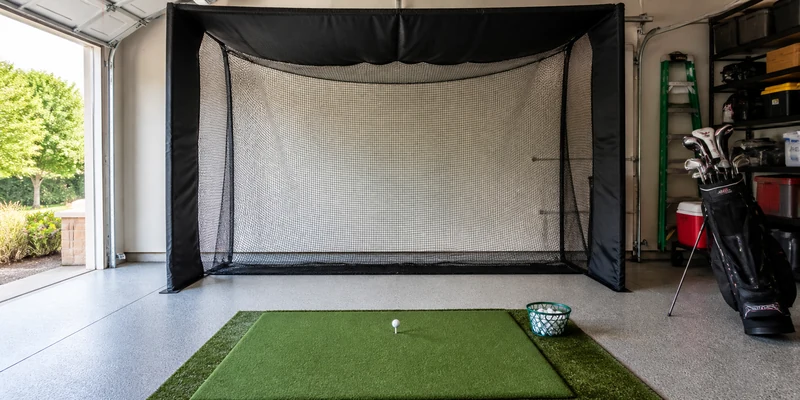
A steel-frame practice cage with loose-hang netting and side coverage, the closest thing to a range stall and the natural foundation if a simulator screen is in your future.

Protecting the Rest of the Garage
Even with a good net, smart golfers layer protection where misses concentrate. One addition covers most of it.
🛡️ Also Great: Side Barrier Netting
A panel of loose-hung netting along the open side of the bay, covering the sideways miss that frontal nets cannot. Cheap insurance for drywall, shelving, and the car parked one bay over.

Hang barrier netting loose rather than taut; slack netting absorbs a ball, tight netting returns it. Move bikes, tools, and anything glass out of the bay entirely, and park the car outside during sessions. The five-minute reset is part of the routine, the same way racking weights is part of a home gym.
From Garage Net to Garage Simulator
Here is the pattern nearly every garage net owner follows: within a few months, hitting into a blank net starts to feel like typing with the monitor off. The swing feels fine, but you have no idea where the ball would have gone. A launch monitor fixes that, reading ball speed, launch, and direction even into a net, and our launch monitor guide covers options from entry-level radar to camera units.
Add a projector and screen, or even just a tablet on a stand, and the same bay becomes a simulator. If that trajectory sounds likely, plan for it now: the cage-style net above doubles as an enclosure frame, and our garage golf simulator guide maps the full build, from layout to software. Buying with the end state in mind is cheaper than buying twice.
Common Mistakes to Avoid
- Testing ceiling height with the actual driver first. Start with a slow-motion swing, then short irons. Finding the ceiling with a full-speed driver is an expensive survey method.
- Crowding the net to save depth. Netting needs distance to decelerate a ball. Respect the listed hitting distance even if it means using a shorter club.
- Leaving the car in the next bay. A shank travels sideways, not forward. If the car is in the garage, it is in play; park it outside for the session.
- Ignoring the ceiling fixtures. Openers, bare bulbs, and fluorescent tubes sit exactly where wedge shots go. Cage or baffle first, or keep lofted clubs out of the rotation.
- Hitting off bare concrete. It stings, it damages clubs, and it teaches you to flinch. A proper hitting mat is part of the minimum setup, not an upgrade.
Where to Go From Here
If you are still comparing nets broadly, the full field is ranked in our hitting net guide. The safety and space guide goes deeper on clearances and aiming rules for any indoor setup. And when the feedback itch arrives, the launch monitor guide and the garage simulator build show what the same bay can become.
Frequently Asked Questions
Can I make a full swing in a standard garage? Often yes, but measure first. Most golfers need roughly 9 to 10 feet of ceiling for a driver swing; many garages offer that between the door tracks, and short irons need less.
Are real golf balls safe to hit in a garage? With a quality net at the recommended distance, side protection, and a cleared bay, many golfers do. Foam balls remain the sensible starting point while you learn your miss pattern indoors.
What stops a shank from hitting the wall? Only side coverage. A frontal net does not extend far enough sideways for a true heel strike, which is why barrier netting or a cage matters in enclosed spaces.
Do I need a mat if my garage floor is smooth concrete? Yes. Concrete transmits impact shock to wrists and clubs and offers no forgiveness on heavy contact. A stand-on mat solves both problems at once.
Can a garage net setup become a simulator later? That is the most common upgrade path in home golf. A launch monitor turns the net into a data station, and a screen turns it into a simulator; our garage simulator guide covers the steps.
The Bottom Line
A golf net for garage practice works when the ceiling clears roughly 9 to 10 feet, the net has top and side protection, and nothing valuable shares the bay during sessions. Buy a baffle-equipped or cage-style net, add a proper mat, and treat the clear-the-bay ritual as part of practice. From there, a launch monitor is the natural next step.