Last updated: August 10, 2026
Golf net safety comes down to one honest sentence that net marketing avoids: a net catches most shots, and your setup has to handle the rest. Golf balls leave the face at highway speeds, mishits leave at strange angles, and the difference between a boring practice habit and a broken window is planning done once, before the first swing.
This is not an argument against home practice; it is the checklist that makes home practice uneventful. Ceiling height, clearances, aiming direction, and a handful of habits, ten minutes of reading that every net owner should do before setup and most do after their first close call.
Quick Answer
How much space does a golf net need, and what makes it safe?
- Indoors, most golfers need roughly 9 to 10 feet of ceiling for a full swing, plus the net maker’s listed hitting distance and free space on all sides of the swing.
- Aim the net somewhere a missed shot lands harmlessly: fence, hedge, open lawn, or bare wall. Never toward windows, cars, neighbors, or the street.
- No net catches every mishit. A true shank exits sideways at a sharp angle, which is why side clearance and direction matter as much as the net itself.
The Space and Safety Checklist
Run through this table with a tape measure before buying or placing a net. Every row is a two-minute check; together they cover nearly every incident story in net reviews.
| Check | Rule of thumb | Why |
|---|---|---|
| Ceiling height (indoor) | Roughly 9 to 10 ft for full swings | Driver swings arc higher than they feel; verify with a slow-motion swing at your actual spot |
| Hitting distance | The distance the net maker lists | Netting needs room to flex and decelerate a ball; too close and balls can rebound or punch through |
| Side clearance | Free space well beyond club reach, both sides | Heel strikes exit sharply sideways, outside the face of a frontal net |
| Behind the net | A few feet of dead air | Netting bulges backward on impact; walls, glass, and cars do not belong in that zone |
| Overhead path | Nothing fragile above the ball flight | Wedges launch steeply; lights, fans, and openers sit exactly where lofted shots go |
| Aiming direction | A miss lands somewhere harmless | The one decision that protects you when everything else fails |
| Bystanders and pets | Nobody beside or ahead of the hitting position, ever | The non-negotiable rule; sessions pause when kids or pets enter the zone |
If you are still choosing the net itself, our hitting net guide ranks the options with these requirements in mind, including baffle-topped and cage designs that shrink several of the risks above.
Why Nets Miss: The Geometry of Mishits
A well-struck shot flies where you aim, which is why nets seem foolproof in demonstration videos. Mishits are the problem. A shot off the heel, the true shank, leaves the club at a sharp sideways angle and can pass entirely beside a frontal net. A thinned wedge skims low and fast and can skip under a net whose base sits loosely. A high-toe strike balloons upward, and steep wedge launches can clear a flat-topped net completely.
None of this makes nets unsafe; it defines their job accurately. A net handles the shots you mostly hit, and the setup, direction, clearance, side coverage, handles the shots you occasionally hit. Plan for your worst contact of the month, not your average swing, and the whole system works.
Indoor Setups: Garage, Basement, and Spare Room
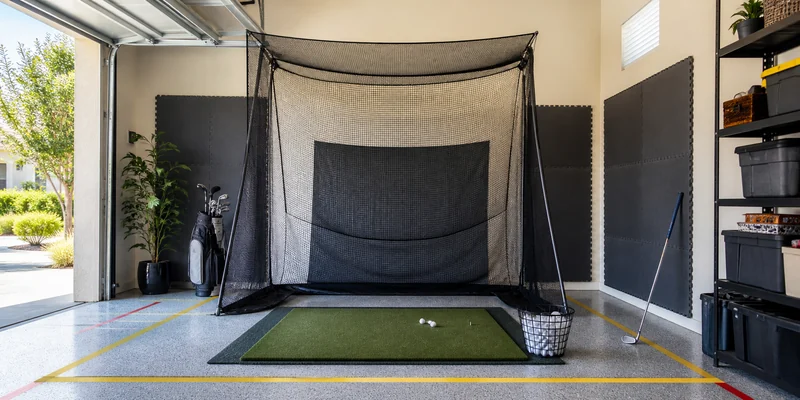
Indoors concentrates every risk into a small box, which is why indoor nets deserve the stricter version of the checklist. Measure ceiling height at the swing spot, not the room’s tallest point, and test with slow-motion swings through the whole bag you plan to use; a driver needs meaningfully more arc than a pitching wedge. Choose a net with a top baffle or a cage design, add side barrier netting where a wall, car, or doorway sits inside the miss zone, and clear the bay of anything you value before every session.
Foam or limited-flight balls are the honest starting point for any new indoor setup. They reveal your miss pattern at a fraction of the consequence, and graduating to real balls after a proven week costs nothing but patience. The garage-specific version of this planning, bay layout, door tracks, lighting, lives in our garage golf net guide, and full room planning for simulator builds is covered in golf simulator room dimensions.
Outdoor Setups: Wind, Neighbors, and Property Lines
Outdoors trades the ceiling problem for two new ones: wind and other people. An unanchored net is a sail, and a gust mid-session can fold it, move it, or drop it onto whatever sits nearby, so stakes or weight bags are an every-session habit, not an installation step. Position the net so that a ball clearing or missing it lands on your own property, ideally against a fence, hedge, or open lawn, and never set up aimed at a neighbor’s yard, a shared driveway, or the street, whatever your confidence level.
Neighbors are also a practical consideration: repeated ball strikes carry sound, and a stray ball over a fence converts instantly into a conversation you did not want. A courteous heads-up and a conservative aiming direction preserve both the practice habit and the relationship. The full outdoor build, net, mat, and feedback, is mapped in our backyard driving range guide.
Net Care: The Part of Safety That Ages
A net is safety equipment, and safety equipment wears. UV exposure stiffens and weakens netting over seasons, impact concentrates wear in the center of the hitting zone, and seams and pole sleeves fray before flat panels do. Inspect the impact zone monthly for thinning, broken strands, or a stretched look, check that poles seat fully and stakes still bite, and retire or patch netting that shows daylight where it should not.
Storage is the cheapest maintenance: a net that comes down between outdoor sessions, or lives in shade, lasts multiple seasons longer than one parked in full sun. Most manufacturers sell replacement netting separately, which converts a worn net into a hardware refresh instead of a new purchase.
Common Mistakes to Avoid
- Finding the ceiling with a full-speed driver. Slow-motion swings answer the height question for free. Full speed answers it with a repair bill.
- Crowding the net to fit a small space. The listed hitting distance is part of the design. If the space cannot provide it, use a shorter club or a different room.
- Treating the first session as the test. Prove a new setup with foam balls and deliberate mishits toward the edges. Discover the gaps cheaply.
- Letting people drift into the zone. Kids, pets, and curious spectators belong behind the hitting position or out of the room. Pausing the session is always the right call.
- Trusting last year’s netting. UV and impact wear are gradual and invisible until they are not. The monthly one-minute inspection is the habit that catches it.
Frequently Asked Questions
How much ceiling height do I need to swing indoors? Most golfers need roughly 9 to 10 feet for a full driver swing; shorter clubs need less. Always verify at your exact hitting spot with slow-motion swings before swinging at speed.
Can a golf ball go through a hitting net? Through intact, properly rated netting at the listed distance, rarely. Through worn netting, undersized chipping mesh, or a net hit from too close, it happens, which is why rating, distance, and inspection all matter.
Do I need side netting? Indoors, or anywhere a sideways miss would hit something valuable, side coverage is the difference between a scare and a story. A frontal net does not extend far enough for a true heel strike.
Are foam balls a permanent substitute for real balls? They can be, especially in tight indoor spaces. Many golfers keep foam for the house and real balls for a properly spaced garage or backyard setup.
Is it safe to hit into a net every day? With correct space, direction, and an inspected net, daily practice is exactly what these setups are built for. The checklist is a one-time cost; the habit is the payoff, as our home practice guide lays out.
The Bottom Line
A safe golf net setup needs roughly 9 to 10 feet of indoor ceiling, the manufacturer’s listed hitting distance, side clearance for the sideways miss, and a direction where a failed catch lands harmlessly. No net catches everything, so the setup covers what the net cannot. Run the checklist once, inspect monthly, and home practice stays exactly as boring as it should be.