Last updated: August 10, 2026
Golf practice at home has a quiet advantage over the driving range: it happens. The range session you plan for Saturday competes with everything else Saturday holds; the putting mat in the hallway competes with nothing. Ten minutes here and there, several days a week, adds up to more deliberate practice than most golfers ever log at the range.
This article lays out a simple, realistic structure for practicing at home: what can be worked on in a normal house, how golfers commonly split their time, and how to keep sessions short enough to survive real life. It is a routine framework, not swing instruction; for technique itself, a teaching professional remains the right source.
Quick Answer
How do you practice golf at home?
- Split short, frequent sessions across three areas: putting, short game, and swing work; ten focused minutes counts as a session.
- Match each area to a simple station: a putting mat in a hallway, a chipping net in the yard or den, and slow-motion or mirror swing work anywhere with ceiling room.
- Consistency beats intensity. A modest routine done most days outworks a marathon session done once a month.
A Realistic Weekly Structure
Here is a framework many golfers use as a starting point, sized for a normal week rather than an ideal one. Shift the balance toward whatever part of your game frustrates you most.
| Area | Sessions per week | What a session looks like |
|---|---|---|
| Putting | 3 to 5 short sessions | 10 minutes on a mat: start-line drills, distance control games, a scored finish |
| Chipping | 2 to 3 sessions | 10 to 15 minutes to a target net: vary clubs and trajectories, keep score |
| Swing work | 2 to 3 sessions | Slow-motion rehearsals, mirror checks, tempo swings; full shots only into a proper net |
| Grip and setup | Daily, incidental | A minute of grip and posture rehearsal while the kettle boils; no equipment needed |
| Full-swing balls | When setup allows | Net sessions with a purpose per session: one club family, one ball-flight focus |
Nothing in that table requires more than a hallway until the last row. That is the point: home practice scales from a putting mat by the couch to a garage bay, and the routine survives at every stage.
Putting: The Highest-Frequency Habit
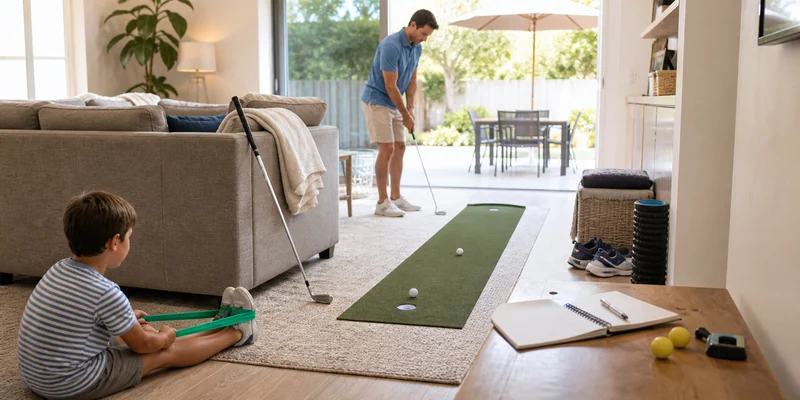
Putting is the part of golf best suited to home practice: no ceiling requirement, no noise, no safety planning, and short putts reward exactly the kind of frequent, brief repetition a home makes easy. Two kinds of work cover most needs. Start-line practice, rolling balls over a spot or through a gate, builds confidence that the ball goes where the face points. Distance games, alternating long and short rolls, train the speed control that decides three-putts.
Keep a scoring element in the last few minutes, such as ten putts from a set distance with a running tally across days. If you do not yet own a surface, mats vary more than they look; see what separates them in our putting mat guide.
Short Game: Small Space, Fast Feedback
Chipping is the second station that fits almost any home. A target net in the yard, or in a den with foam balls, gives every rep a visible result, and varying the club and trajectory between rounds keeps the practice honest rather than robotic. Many golfers structure it as a simple pocket game: ten balls per target, count the makes, rotate clubs.
The equipment barrier is genuinely low here; the options are compared in our chipping net guide. If you have outdoor space to pair the net with a green, the backyard putting green guide shows how a short-game corner comes together.
Swing Work Without Hitting a Ball
A surprising amount of swing maintenance needs no ball at all. Slow-motion rehearsals let you feel positions that full speed hides. A mirror or a phone propped on a shelf gives visual feedback on setup and posture. Tempo swings with any club, or with a weighted trainer, keep the motion oiled between rounds; the category is covered in our swing trainer guide. Check ceiling clearance before any indoor swing, even a rehearsal; light fixtures lose these encounters.
What ball-free work is not is a substitute for technical instruction. If something in the swing feels genuinely broken, a lesson diagnoses it faster than a winter of unguided rehearsal. Home practice maintains and grooves; a teaching professional repairs.
Full Swings at Home: The Equipment Threshold
Hitting real balls at home is where equipment and planning enter. The minimum is a full-size hitting net and a proper mat, set up with the clearances and safe direction covered in our safety and space guide; the buying side lives in the hitting net roundup. From there, a launch monitor restores the feedback that a net removes, reporting ball speed, launch, and carry for every swing; our launch monitor guide ranks the options.
The full expression of the idea is a simulator, where the net becomes a screen and practice becomes rounds; that path is mapped in our home simulator guide. None of it is required for a useful routine, but each step raises what a home session can cover.
Common Mistakes to Avoid
- Planning sessions too long to repeat. A 45-minute plan gets done twice. A 10-minute plan gets done all winter. Size the habit to your life, not your ambition.
- Practicing without a target or score. Aimless rolling and chipping feels productive and measures nothing. Every session deserves one number to beat.
- Only practicing the fun part. If putting is the weakness, another hour of net swings will not touch it. Let your scorecard set the schedule.
- Swinging indoors without a ceiling check. Rehearsal swings count too. Test clearance in slow motion before any club moves at speed inside.
- Expecting practice to replace instruction. Home reps groove what you already do. If what you do needs changing, that is a lesson, not a routine.
Building Your Own Version
Start with one station this week, the one aimed at your most annoying weakness, and run it for two weeks before adding anything. Most golfers land on a putting mat first because it demands the least space and planning, add a chipping net the following month, and only then decide whether the full-swing station is worth the setup. The gear ladder is covered across our guides to putting mats, chipping nets, and hitting nets; the routine above works at every rung.
Frequently Asked Questions
How often should you practice golf at home? Short sessions most days beat long sessions occasionally. Many golfers settle on 10 to 15 minutes, four or five days a week, split across putting, chipping, and swing work.
Can you really practice golf in a small apartment? Putting, grip work, and slow-motion rehearsals fit almost any floor plan, and a chipping net with foam balls fits most. Full swings need ceiling height and a proper net.
Does home practice actually transfer to the course? Practice builds repetition and comfort; how that shows up on the course varies by golfer. Structured, scored practice with targets transfers better than casual repetition, which is why every drill here keeps score.
What is the best first purchase for home practice? For most golfers, a quality putting mat: lowest space requirement, highest usage frequency, and putting is a large share of scoring. Our putting mat guide covers the field.
Do I need a launch monitor to practice at home? No. It becomes valuable once you hit full shots into a net regularly and want feedback on each swing; before that stage, targets and scoring provide plenty.
The Bottom Line
Golf practice at home works when it is small, frequent, and scored: putting most days, chipping a few times a week, swing rehearsals in between, and full shots only with a proper net and safe space. Build one station at a time, keep sessions short enough to repeat, and let your weaknesses set the schedule. The routine that fits your life is the one that compounds.