Last updated: August 10, 2026
Shopping for a putting mat starts with an uncomfortable truth: most of them end up rolled behind a couch within a month. The mats that survive share two qualities. They roll honestly enough that practice on them feels like practice on a real green, and they are easy enough to leave out that you actually use them. Roughly half of the strokes in an average round happen on the green, so a mat you use daily is one of the highest-leverage pieces of practice gear you can put in a house.
This guide walks through what separates a good mat from a novelty: surface and roll quality, length and width, targets versus real cups, and the training aids printed on the surface. Along the way it points to the mats that come up again and again in golfer feedback, from budget turf runners to premium true-roll surfaces.
This article contains affiliate links. If you buy through them, we may earn a commission at no extra cost to you. Learn more.
Quick Answer
Which putting mat should you buy?
- For most golfers, a 9 to 10 foot mat with a consistent, medium-fast roll and simple alignment guides is the sweet spot: long enough for meaningful putts, short enough to leave out at home.
- Choose a ball-return design if rep volume is your goal, or a plain true-roll turf mat if you want the surface to feel as close to a real green as possible.
- Buy for your space first. Measure the spot where the mat will actually live before you fall for a 13 foot training system.
What to Check Before You Buy
Every row below is something you can verify from a product listing before you commit. Get the first three right and the mat will earn its floor space.
| What to check | Why it matters | What to look for |
|---|---|---|
| Surface and roll | A bumpy or grabby surface teaches you nothing about pace | Dense, low-pile turf or velvet-style surfaces that golfers describe as rolling like a medium-fast green |
| Length | Short mats only train short putts | 9 to 10 feet for most homes; longer training mats if you have the hallway or basement for them |
| Width | Narrow runners limit you to one straight line | Wider mats allow start-line drills, gates, and putts from slightly different angles |
| Lie flat behavior | A mat with ripples ruins every putt across them | Heavier backed mats, or listings where owners confirm the mat flattens quickly after unrolling |
| Hole or target | Cups, printed targets, and ramps train differently | A regulation-size cup or cutout feels most like golf; targets and gates are better for start-line work |
| Training markings | Guides can help or clutter depending on your taste | Alignment lines and distance marks help most golfers; some prefer a clean surface that looks like a green |
If your real question is bigger than a mat, our guide to a full indoor home putting green covers larger roll-out greens and dedicated setups, and the backyard putting green guide handles the outdoor version.
Surface Quality: Where Cheap Mats Lose You
The surface is the product. A good putting mat uses dense, consistent fibers that let the ball roll out smoothly and at a believable pace, usually somewhere golfers compare to a medium or medium-fast green. A bad mat grabs the ball, releases it unevenly, or shows seams and ripples that knock putts offline. When that happens, your brain stops trusting the feedback, and the mat becomes decoration.
Backing matters almost as much as pile. Heavier rubber or foam backing helps a mat lie flat on hard floors and stay put on carpet, and it is the difference between a surface that feels planted and one that shifts under your feet. Owner feedback is the best signal here: recurring comments about ripples, curling edges, or dead spots are worth taking seriously, because those flaws rarely improve with time.
Hole, Target, or Ball Return: Pick Your Training Style
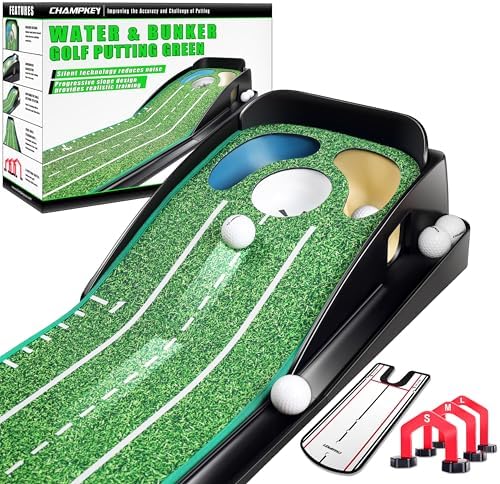
Mats resolve the “what am I putting at” question three ways, and each suits a different golfer. A regulation-size cup or cutout is the most honest: the ball either drops or it does not, exactly like on the course. Printed targets and gates shift the focus to start line and pace, which is where most amateurs actually leak strokes. Ball-return designs use a ramp or track to send the ball back to your feet, which sounds like a gimmick until you realize it doubles how many putts you hit in ten minutes.
None of these is wrong. If you love the feel of holing putts, buy a cup. If you are drill-oriented, buy targets and markings. If you know yourself well enough to admit that walking after balls kills your practice sessions, the ball return mats we cover separately are built for you.
Our Top Picks at a Glance
How we chose: we compared widely available putting mats on roll consistency, how flat they lie, build quality, and the training value of their layouts, leaning on manufacturer specifications and recurring themes in golfer reviews rather than any hands-on trial of our own.
One reassurance before the list: every pick here rolls at a pace golfers consistently describe as close to a real green, because a believable roll is the baseline for a mat you will still be using next season.
🏆 Best Overall
A heavily marketed mat that earns the attention: a smooth, quick-rolling surface, alignment guides down the middle, two hole sizes so you can make the target harder, and an automatic ball return track. Golfers consistently mention how easy it makes high-volume practice. Read the full breakdown in our Perfect Practice review.

💛 Best Value
A straightforward turf mat with alignment markings and a consistent roll for noticeably less than the big training names. Reviews mention that it lies flat quickly and survives daily use, which is most of what a putting mat needs to do.
⭐ Upgrade Pick
A premium cut-pile turf mat with a regulation cup and no printed clutter, built to look and roll like a real green indoors or on a patio. The pick for golfers who care more about feel than about training graphics. Full thoughts in our PrimePutt review.

Picks by Training Style: Speed, Structure, and Volume
The three mats above cover most buyers. These three earn a place when your practice has a more specific shape; each links to a deeper review or guide if the situation matches yours.
🎯 Best for Speed Control
A high-speed mat printed with distance zones and pace targets, paired with a free companion app full of structured drills (some app content sits behind a paid tier, which is worth knowing upfront). The surface rolls at a pace golfers compare to a fast, well-kept green. Details in our Wellputt review.

🧳 Best Compact System
A slim mat with printed start-line and pace guides that pairs naturally with the brand’s well-known pressure trainer ramp, so a hallway becomes a complete short-game station. We break the pieces down in our PuttOut review.

🔁 Best with Ball Return
A proven rep-volume design: a narrow runner with a raised cup and gravity return that sends made putts back to your feet, plus a visible ball path that shows push and pull misses instantly. More options in our ball return roundup.

Placement, Care, and Living With It
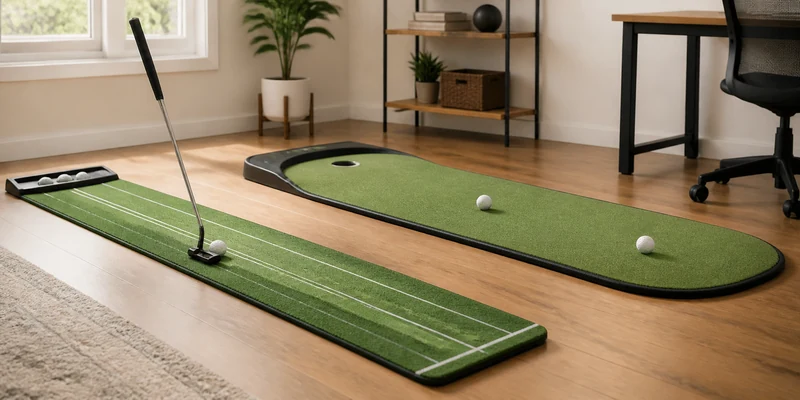
Where the mat lives decides whether it gets used. A hallway, a home office, or the space beside a desk beats a closet every time, because friction kills practice habits faster than any flaw in the mat. Hard floors give the truest roll; on thick carpet, the ball can wander, so a firmer backed mat or a thin board underneath helps. If your mat shipped rolled, give it a day or two flat, weighted at the corners if needed, before judging the surface.
Care is simple: vacuum the surface occasionally, keep street shoes off it, and store it loosely rolled rather than folded, since hard creases are the one injury most mats never recover from. If your practice corner is turning into a full setup with a net and a launch monitor, our home practice guide shows how the pieces fit together.
Common Mistakes to Avoid
- Buying longer than your room. A 13 foot mat in a 12 foot room becomes a 0 foot mat in a closet. Measure the real spot, including your stance behind the mat.
- Chasing a perfectly true roll on a novelty surface. Thin felt mats with cartoon graphics rarely roll honestly. If the listing never mentions the surface or pace, assume the worst.
- Ignoring width. A ball-width runner limits you to one drill forever. A little width buys gates, start-line work, and putts from new angles.
- Treating the mat as a substitute for reading greens. Most mats are flat and straight. They sharpen your stroke and pace; slope reading still needs the course or a breaking putt setup.
- Putting it away after every session. The mat that stays on the floor gets used. Pick a size you can live with seeing daily.
Where to Go From Here
If you want something closer to a real green than a runner, the indoor putting green guide covers larger roll-out surfaces and dedicated rooms. If your practice happens between meetings, the office putting mat guide picks mats that behave in a workplace. And if you are curious how a putting corner fits into a bigger home setup, our home golf simulator guide shows what the full picture looks like.
Frequently Asked Questions
What length putting mat is best? For most homes, 9 to 10 feet. That covers the short putts that decide scores while still fitting a hallway or office. Longer mats add value for lag putting if you genuinely have the space.
Do putting mats actually help? They give you far more repetitions on stroke mechanics and pace than occasional course play alone, and many golfers use them daily for exactly that reason. What they cannot do is teach you to read real slopes and grain.
How fast do putting mats roll? Most quality mats roll at a pace golfers compare to a medium or medium-fast green, and some training mats intentionally run faster. Listings that describe the roll, and reviews that confirm it, are a good sign.
Can I use a putting mat on carpet? Yes, though thick carpet underneath can soften the roll. A firmer backed mat, or a thin board under the surface, keeps things honest. Hard floors are the ideal base.
Which putting mat looks most like a real green? Premium cut-pile turf mats like the one in our PrimePutt review are the closest visual and feel match. Training mats trade some of that realism for printed guides.
The Bottom Line
The best putting mat for most golfers is a 9 to 10 foot surface with a consistent, medium-fast roll, simple alignment help, and a footprint you can leave out permanently. Rep-focused golfers should lean toward ball return designs, and feel-focused golfers toward premium turf. Buy the mat that fits the space you actually have, and it will pay you back every day.