Last updated: August 10, 2026
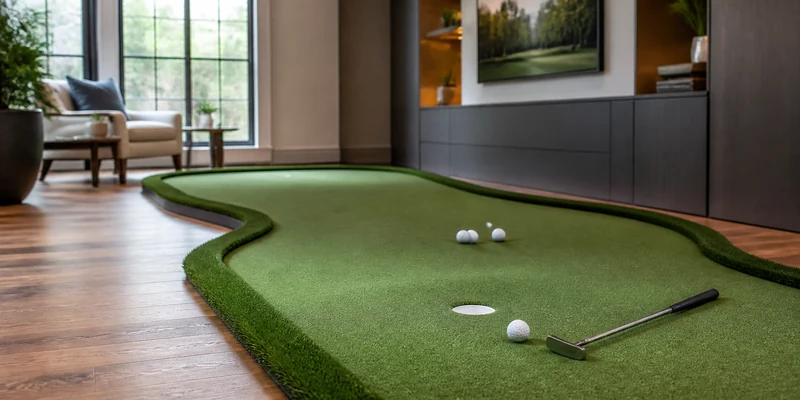
Searching for a home putting green indoor setup usually means you have outgrown the idea of a novelty mat and want something that feels like golf. The good news is that the answer depends almost entirely on one thing you already know: the room. A hallway supports a very different green than a basement, and a basement supports a different green than a spare room you are willing to hand over to the game entirely.
This guide is organized exactly that way, answer first, by space. You will find the right format for each room size, what separates a green that rolls true from one that frustrates you, and the specific products golfers keep coming back to in each class, from compact runners to room-filling roll-out greens.
This article contains affiliate links. If you buy through them, we may earn a commission at no extra cost to you. Learn more.
Quick Answer
What is the best indoor putting green for your space?
- Hallway or office (up to about 10 ft): a quality 9 to 10 foot putting mat with a consistent roll is the honest answer; a bigger green will not fit and will not get used.
- Basement or spare room (10 to 15 ft): a wide roll-out green or premium turf mat in the 12 foot class gives you real lag putts, angles, and drills.
- Dedicated golf room (15 ft and up): a large multi-hole green, optionally with break inserts, turns putting into a permanent feature rather than a rolled-up accessory.
The Right Green for Each Space
Start with the row that matches your room. Everything else in this guide builds on this table.
| Your space | Best format | What it gives you |
|---|---|---|
| Hallway, office corner (6 to 10 ft) | 9 to 10 ft putting mat, ball return optional | Daily short-putt reps, stroke and start-line work, rolls away in seconds |
| Living room (8 to 12 ft) | Premium turf mat with regulation cup | A green that looks good enough to leave out, honest roll, real cup feel |
| Basement or spare room (10 to 15 ft) | Wide roll-out green, 12 ft class | Lag putting, multiple angles and hole positions, room for gates and drills |
| Dedicated golf room (15 ft and up) | Large multi-hole green with break options | Breaking putts, several stations, a permanent practice fixture |
| Shared with a simulator | Putting surface matched to the sim flooring | One room that covers full swings and the short game together |
If your space tops out at the first row, our putting mat guide goes deeper on that category. If you are lucky enough to be in the last row, the home simulator guide shows how putting fits into a full build.
What Makes an Indoor Green Roll True
Surface density is the whole game. Quality indoor greens use dense, short-pile turf or pressed surfaces that let the ball hug the ground and release smoothly, at a pace most golfers compare to a medium-fast green. Cheaper surfaces are essentially carpet with a hole: the ball bounces, wanders, and stops unpredictably, which teaches your hands lessons you will have to unlearn outdoors.
Flatness is the second battle, and it is mostly about backing and mass. Larger roll-out greens with heavy backing settle flat and stay flat; light mats ripple at the seams and edges. Owner feedback is the most reliable signal, since ripple complaints show up quickly and repeatedly when a product has the problem. Give any rolled green a day or two to relax after unboxing before judging it.
Small Spaces: The Hallway and Office Answer
Under about 10 feet, the format question answers itself: you want a mat, not a green. The difference is more than words. Mats are narrow, light, and built to be rolled away, while true greens are wide, heavy, and meant to stay down. In a hallway, the mat’s weaknesses stop mattering and its strengths, daily availability and zero setup, take over.
Within that format, buy exactly as if you were reading our best putting mat guide: consistent roll, honest length, and either a cup or a ball return depending on whether you value realism or rep volume. If the mat will live where you work, the office putting mat guide covers the quieter, tidier end of the category.
Our Top Picks by Space
How we chose: we compared indoor putting greens on roll consistency, surface quality, how flat they settle, and how well each format fits its intended room size, based on manufacturer specifications and recurring themes in golfer reviews rather than hands-on testing of our own.
A note on sizes: most of these lines come in several lengths and widths, so treat the pick as a pointer to the range and choose the dimensions your room measured, not the dimensions you wish it had.
🏆 Best Overall Roll-Out Green
A wide, heavy-backed roll-out green in the 12 foot class with a surface golfers consistently describe as smooth and true, plus multiple cup positions for varied practice. The step up from a mat that makes a basement feel like a practice facility.

💛 Best Value
A wide putting green at a friendlier price that keeps the essentials: a consistent roll, several hole positions, and enough width for angle work. Reviews mention it settles flat quickly, which is where budget greens usually fail.

⭐ Upgrade Pick for Living Spaces
A premium cut-pile turf mat with a regulation cup and no printed graphics, designed to look like a real green in a room guests actually see. The choice when aesthetics and feel outrank drill features. Full thoughts in our PrimePutt review.

Picks for Tight Spaces and Sloped Practice
Two more situations come up constantly in this category; each has a natural answer and a deeper guide.
🔁 Best Compact Green
A hallway-friendly mat with a ball return track, so limited space converts into unlimited repetitions instead of walking after balls. The full category is covered in our ball return roundup.
⛰️ Best for Breaking Putts
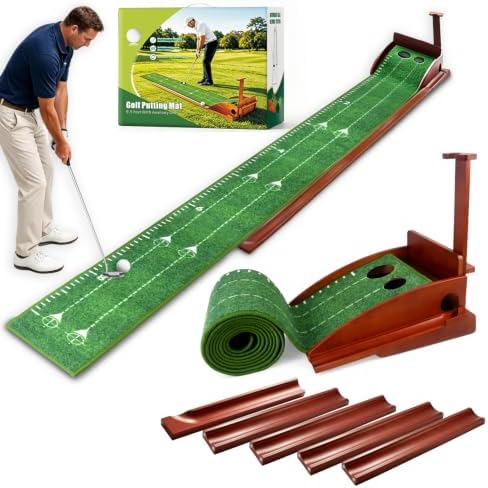
A putting green system with adjustable ramps and inserts that create real left-to-right and right-to-left break, the one skill flat mats cannot touch. We cover the approach in depth in our breaking putt guide.

Setting It Up: Floors, Light, and Layout
Hard, level floors are the ideal base; over carpet, a heavier green with dense backing keeps the roll honest, and a thin underlayment board can rescue a wavy surface. Leave walking space on at least one long side so you can putt from different spots, and place the green where normal household traffic will not fold the edges. Light matters more than people expect: a lamp raking across the surface reveals pace and line far better than a dim corner.
If the green shares a room with a hitting bay, lay it perpendicular to the swing area rather than behind the hitting position, so putting practice never happens in the path of a mishit. Our golf man cave guide shows a few layouts where the putting surface and the simulator coexist comfortably.
Common Mistakes to Avoid
- Buying the aspirational size. A 15 foot green in a 12 foot room means permanent ripples against the wall. Measure, subtract stance room, then buy.
- Expecting break from a flat green. Most indoor greens are intentionally flat. If sloped practice is the goal, buy a system built for it from the start.
- Ignoring width. Length gets the attention, but width is what unlocks angles, gates, and multiple hole positions. A wide 10 foot green often beats a narrow 13 foot runner.
- Judging the roll on day one. Nearly every rolled surface needs a day or two, sometimes with weight on the corners, before it shows its true behavior.
- Letting it become storage. The moment boxes land on the green, practice ends. Give it a spot with a purpose, even a modest one.
Where to Go From Here
If a compact mat is the realistic answer for your space, start with the best putting mat guide and its reviews. If your putting green dream lives outside, the backyard putting green guide covers turf that survives weather. And for building putting into a consistent weekly habit rather than an occasional novelty, our home practice guide lays out routines that stick.
Frequently Asked Questions
How much space do I need for an indoor putting green? A useful minimum is about 9 feet of putt length plus 2 to 3 feet behind the ball for your stance. Wider is more valuable than longer once you pass 10 feet of length.
What surface is best for an indoor putting green? Dense, short-pile turf or pressed surfaces with heavy backing roll most consistently, at a pace golfers usually compare to a medium-fast green. Thin carpet-style surfaces are the ones to avoid.
Can I put an indoor green on carpet? Yes, though plush carpet softens and slows the roll. Heavier greens handle it better, and a thin board underneath restores firmness if needed.
Are indoor putting greens worth it? For golfers who will actually use them, they offer far more putting repetitions than course visits alone, which is why many golfers make them a daily habit. The key is buying a format your space genuinely supports.
Indoor green or full simulator first? They solve different problems. A putting green costs less and covers the shots you hit most; a simulator covers the full bag. Many golfers start with putting and grow from there.
The Bottom Line
The best indoor home putting green is the one your room actually fits: a 9 to 10 foot mat for hallways, a wide roll-out green in the 12 foot class for basements and spare rooms, and a large multi-hole green with break options for dedicated spaces. Prioritize a dense, flat-settling surface with an honest roll, and match the format to the room before falling for features.