Last updated: August 10, 2026
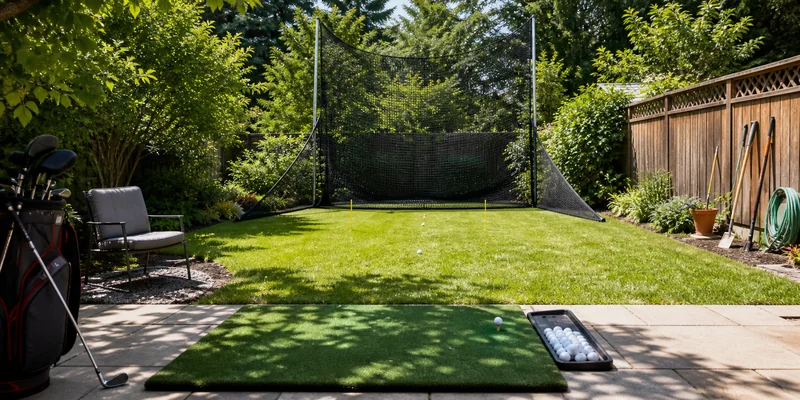
A backyard driving range sounds like a rich man’s project until you list what it actually takes: a hitting net, a mat, and, if you want real feedback, a launch monitor. Three purchases, one afternoon of setup, and the walk to your practice tee is shorter than the walk to your car.
This guide covers the full build in the order that makes sense: the space check that decides everything, the net and mat that form the station, the launch monitor that turns swings into data, and the habits that keep the neighbors friendly and the windows intact.
This article contains affiliate links. If you buy through them, we may earn a commission at no extra cost to you. Learn more.
Quick Answer
What do you need for a backyard driving range?
- Three components: a full-size hitting net, a stand-and-hit mat, and optionally a launch monitor for ball data; that combination covers most of what a commercial range offers.
- Aim the net at a fence, hedge, or open lawn, never toward windows, neighbors, or the street, and give it clearance on all sides.
- Start with net and mat, add the launch monitor when hitting into a blank net stops being satisfying; that upgrade moment comes for almost everyone.
The Three-Part Build at a Glance
Everything in a backyard range maps to one of three jobs: stop the ball, protect your body and lawn, and tell you what the ball did. This table is the whole project.
| Component | Job | What to look for |
|---|---|---|
| Hitting net | Stops the ball safely | Full-size flex-pole or cage net with heavy-duty netting, staked or weighted against wind |
| Hitting mat | Protects wrists, clubs, and lawn | A 4 by 5 foot class stand-and-hit mat with dense turf and a thick base |
| Launch monitor | Turns swings into feedback | A radar unit that tracks ball speed, launch, and carry outdoors; optional but transformative |
| Practice balls | Lower-risk option for tight yards | Limited-flight or foam balls while you learn your miss pattern |
| Placement | Keeps practice boring and safe | A safe direction, clearance around the net, and respect for property lines |
Before choosing a spot, spend five minutes with our golf net safety and space guide. Outdoors the stakes are windows, cars, and neighbors, and the aiming rules there are the foundation this whole project stands on.
Picking the Spot: Direction Before Distance
The best location is not the biggest patch of lawn; it is the direction with the most forgiving miss. Face the net toward a fence, a hedge, a hillside, or open grass, so that a ball clearing or missing the net lands somewhere harmless. Never set up aimed at your own house, a neighbor’s yard, or the street, no matter how confident you feel, because no net catches every mishit and a true shank exits sideways at a sharp angle.
Also think about sun and footing. A west-facing hitting position means squinting through evening sessions, and a sloped lie changes every swing. Flat ground, a neutral sun angle, and a boring background beat a scenic spot that only works when nothing goes wrong.
Our Backyard Range Picks
How we chose: we compared widely available nets, mats, and launch monitors on durability, outdoor suitability, and how consistently owners report them holding up to weather and full-speed use. Selections lean on manufacturer specifications and recurring themes in customer reviews rather than any hands-on trial of our own.
These three together form a complete range. Buy them in this order and the setup works at every stage.
🏆 The Net: Best Overall
A heavy-duty hitting net with an angled top baffle that knocks down steep wedge shots, which matters outdoors just as much as in, since the ball that clears a flat net is the one that finds a window.

🌱 The Mat: Best Overall
A 4 by 5 foot stand-and-hit mat with dense turf and a forgiving base. It saves the lawn, spares your wrists, and gives every swing the same flat lie, which no patch of backyard grass does.

📡 The Launch Monitor: Best Overall
A portable radar unit that tracks ball speed, launch, carry, and direction in exactly this setting: outdoors, into a net, off a mat. Core metrics work out of the box; some app features sit behind an optional subscription tier, which is worth checking against your needs.

Rounding Out the Range
Two additions turn a hitting station into a practice ground, and both cost less than a season of range buckets.
🎯 Also Great: A Chipping Net
A target net for wedge work from real backyard lies, the practice with the fastest payoff per minute. Our chipping net guide compares the options.

🟡 Also Great: Limited-Flight Practice Balls
Foam or limited-flight balls that let you practice full swings in yards too tight for real balls, and let new setups prove themselves before the stakes go up.

If putting is the weak spot in your game instead, the same square footage can host a green; that build is covered separately in our backyard putting green guide.
The Launch Monitor Question
You can run a backyard range without data, and plenty of golfers do. But hitting into a net removes the one feedback loop golf normally provides, watching the ball fly, and repetition without feedback mostly grooves whatever you already do. A launch monitor restores the loop: every swing returns numbers for ball speed, launch, and carry, so a practice session becomes measurable instead of merely sweaty.
Radar units suit backyards particularly well because radar tracks the ball outdoors with room behind the hitting position, the exact geometry a backyard range has. If the numbers themselves are new territory, our plain-language explainer on launch monitor numbers covers what each one means, and the full field from budget to premium is ranked in our launch monitor guide, with travel-friendly options in the portable launch monitor roundup.
Weather, Storage, and Keeping It Alive
The difference between a backyard range that lasts years and one that dies by August is storage discipline. Wind is the net’s enemy: stake it or weight it every session, and take it down or fold it flat when storms roll through, because a net is a sail with poles. Sun is the mat’s enemy: store it in shade or on edge in the garage, and bring the launch monitor inside always, since electronics and dew disagree.
A five-minute setup and teardown routine sounds tedious and becomes automatic within a week. The golfers who keep their gear outside year-round are the ones writing the one-star durability reviews.
Common Mistakes to Avoid
- Aiming at anything you cannot afford to hit. Direction is the one decision you cannot patch later. Fence, hedge, or open lawn; never windows, neighbors, or street.
- Skipping the mat to save money. A week of daily swings turns grass into dirt, and hitting off dirt is worse for your clubs and joints than any mat.
- Buying the launch monitor first. Data without a safe, comfortable station gets used twice. Net and mat first; the monitor rewards a habit that already exists.
- Leaving everything outside. Wind moves nets, sun ages turf, moisture kills electronics. Teardown is part of the session.
- Testing a new setup with real balls. Run the first sessions with limited-flight balls until the net, distances, and your miss pattern are proven.
Where to Go From Here
Each component has a deeper guide: the hitting net roundup for the full field of nets, the hitting mat guide for turf and base quality, and the launch monitor guide for the data side. If your climate makes outdoor practice seasonal, the same three components move indoors; that version of the project is the garage golf simulator.
Frequently Asked Questions
How much space does a backyard driving range need? Enough for the net, the listed hitting distance in front of it, your stance and swing, and clearance on all sides. Many suburban yards qualify; the direction of the miss matters more than raw square footage.
Do I need a launch monitor for a backyard range? No, but it is the upgrade that keeps practice engaging. Hitting into a blank net goes stale for most golfers; numbers give every session a scoreboard.
Can I hit driver in my backyard? With a full-size net, proper distance, and a safe direction, many golfers do. Work up through the bag over several sessions rather than opening with the big stick.
Real balls or practice balls outside? Real balls give real feedback and real consequences. Limited-flight balls are the smart default in tight yards and for new setups; graduate deliberately.
What about hitting into a net all winter? The setup moves indoors surprisingly well if you have garage or basement height; our garage net guide covers the indoor version of this exact build.
The Bottom Line
A backyard driving range is three purchases: a baffle-equipped hitting net, a stand-and-hit mat, and a radar launch monitor when you want feedback. Pick a direction with a harmless miss, anchor the net every session, and store gear out of the weather. Built this way, the range gets used daily, which is the entire point.