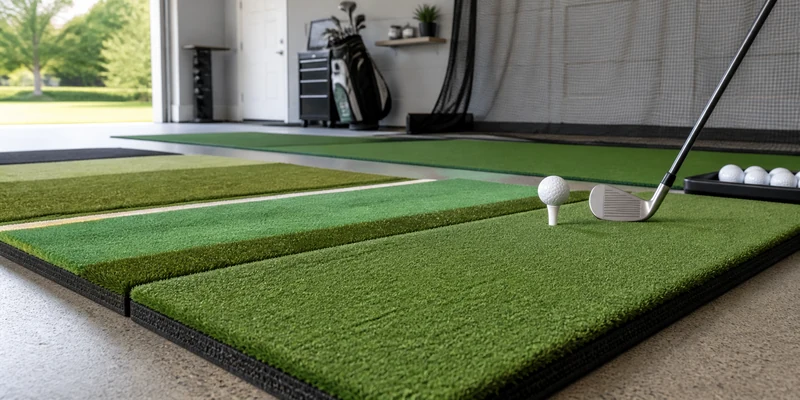
Last updated: August 10, 2026
A golf hitting mat is the least glamorous purchase in a home setup and the one you will touch every single session. It is the surface between your club and a concrete floor, the thing that decides whether a fat shot stings your wrists or slides harmlessly through, and the reason your lawn is not a dirt patch by June.
Cheap mats and good mats look nearly identical in photos, which is exactly why this category punishes casual shopping. This guide explains what separates a mat that feels like a fairway from one that feels like carpet over cement, which models earn consistent owner praise, and how to pick the right size for a net station, garage bay, or future simulator.
This article contains affiliate links. If you buy through them, we may earn a commission at no extra cost to you. Learn more.
Quick Answer
Which golf hitting mat should you buy?
- For most golfers, a mat in the 4 by 5 foot class with dense turf and a solid backing, like the widely praised GoSports 4×5, hits the balance of feel, stability, and floor coverage.
- Small tri-turf or single-hitting-strip mats save money and space but you stand on the floor, not the mat, which changes your setup height off hard surfaces.
- Thin economy mats are the one purchase to skip: they wear fast and transmit shock to wrists and elbows on heavy contact.
What to Check Before You Buy
Mat listings love photos of turf texture and skip the details that matter. These are the ones to verify.
| What to check | Why it matters | What to look for |
|---|---|---|
| Size class | Decides whether you stand on the mat or the floor | Around 4 by 5 feet to stand and hit on one surface; smaller mats are hitting-strip only |
| Turf density | Sparse turf exposes the backing and wears in one spot | Dense, springy nylon turf that holds a tee upright and recovers after strikes |
| Backing and thickness | The shock absorber between club and concrete | A thick foam or rubber base; owners often mention wrist comfort as the tell |
| Tee options | Rubber tees and real tees behave differently | Included rubber tees in multiple heights, or turf dense enough to hold wooden tees |
| Edge and curl | Curling corners are a trip hazard and a sign of a thin base | A heavy backing that lies flat out of the box after settling |
| Ball marks feedback | Some turf shows a strike line you can read | A brushed surface that briefly shows club path is a free practice aid |
A mat almost always lives in front of a net, so if you are building the station from scratch, start with our hitting net guide and the space checklist in golf net safety and space.
Why Mat Thickness Is a Comfort Issue, Not a Luxury
Every golfer hits the ground sometimes; that is what a descending strike does. On grass the turf gives. On a thin mat over concrete, the club stops abruptly and the shock travels up the shaft into wrists and elbows. Reviews of budget mats mention this constantly, and it is the main reason people stop practicing on a mat they technically own.
Thicker, denser mats let the club glide through impact the way turf does, which keeps long sessions comfortable and keeps your swing honest, since you are not subconsciously picking the ball clean to avoid the sting. If you practice more than casually, base quality is the single best place to spend.
Stand-On Mats vs Hitting Strips
Full-size mats put your feet and the ball on the same level, which mirrors how you stand on a course and keeps your posture consistent. That consistency matters more than it sounds: on a raised hitting strip with your feet on the floor, the ball sits above your feet, which changes the lie angle every swing.
Hitting strips and tri-turf mats still have a place. They are light, cheap, easy to store, and fine for occasional sessions or chipping practice. Just know which trade you are making, and if the mat will live in a permanent bay, buy the full-size version once instead of upgrading later.
Our Top Picks at a Glance
How we chose: we compared widely available hitting mats on turf density, base thickness, size, and how consistently owners report them staying flat and comfortable after months of use. Selections lean on manufacturer specifications and recurring themes in customer reviews rather than any hands-on trial of our own.
If you are worried a mat is overkill next to a net, consider that the mat is the part your body interacts with on every swing. It earns its spot faster than any other accessory.
🏆 Best Overall
A 4 by 5 foot stand-and-hit mat with dense turf and a substantial backing, from the same brand behind our favorite hitting nets. Owners consistently mention that it lies flat, holds tees, and feels forgiving on mishits.

💛 Best Value
A well-reviewed mat that undercuts the premium names while keeping the details that matter: dense turf, included rubber tees, and a base that resists curling.

⭐ Upgrade Pick
A simulator-grade mat with a thicker shock-absorbing base and premium turf, built for golfers hitting daily volume indoors. The class of mat you buy once and forget about.

Picks for Small Spaces and Simulator Bays
Two more situations come up constantly in reader questions, and each has a better answer than forcing the standard mat to fit.
🎒 Best Portable
A tri-turf mat with fairway, rough, and tee surfaces in a carry-friendly footprint. Ideal for chipping in the yard and stashing in a closet, as long as you accept standing off the mat.

🖥️ Best for Simulator Bays
A large-format mat sized so both feet and ball share one level surface in front of a screen. If this is your direction, our dedicated simulator mat guide compares the options in depth.

Placement, Care, and Making It Last
Put the mat on a flat, hard surface; on grass or gravel it flexes and wears unevenly. Rotate the mat a quarter turn every few weeks so strikes spread across the turf instead of digging one bare lane, and brush the turf occasionally to keep fibers upright. Indoors, a rubber underlayment quiets impact and protects flooring, a trick borrowed from garage gym setups.
Outdoors, the enemies are sun and standing water. UV fades and stiffens turf over seasons, so store the mat in shade or bring it in between sessions, and stand it on edge to drain after rain. Treated this way, a quality mat commonly outlasts several sets of the netting it faces. For the full outdoor build around it, see our backyard driving range guide.
Common Mistakes to Avoid
- Buying the thinnest mat that ships free. Economy mats transmit shock and wear through quickly, and most people replace them within a year. Buy the mid-tier once instead.
- Ignoring where your feet go. If you want a consistent setup, your feet and the ball belong on the same level. Hitting strips are a compromise, not an equal.
- Hammering wooden tees into dense turf. Use the included rubber tees or a dense-turf mat designed to grip tees; forcing tees tears the surface over time.
- Never rotating the mat. One bare stripe in the middle is the signature of a mat that was never turned. Rotation spreads wear and doubles useful life.
- Putting a mat on soft ground. A mat needs firm support underneath. On lawn, add a plywood or paver base, or the sweet spot will feel different every week.
Where to Go From Here
The mat pairs with a net, so if that side is unsettled, our hitting net guide is the natural next read. If your bay is in the garage, the garage golf net guide covers layout and ceiling checks. And once mat and net are in place, a launch monitor adds the missing feedback loop; the field is ranked in our launch monitor guide.
Frequently Asked Questions
What size golf hitting mat do I need? If space allows, a mat around 4 by 5 feet lets you stand and hit on one surface, which keeps your setup consistent. Smaller mats work for chipping and occasional practice.
Do hitting mats damage clubs? Quality mats with dense turf and a forgiving base are gentle on clubs. Thin mats over concrete are the combination that scuffs soles and stresses shafts on fat shots.
Can I leave a hitting mat outside? For a while, yes, but sun and moisture age turf. Shade, drainage, and bringing it in between sessions meaningfully extend its life.
Are simulator mats different from regular hitting mats? Mostly in size and base thickness, since simulator bays see high volume indoors. Our simulator mat guide covers what changes when a screen enters the picture.
Why do mats include rubber tees? Rubber tees friction-fit into the turf at fixed heights and survive thousands of strikes. Dense mats also hold wooden tees, but rubber is the default for daily practice.
The Bottom Line
The best golf hitting mat for most golfers is a 4 by 5 foot stand-and-hit model with dense turf and a thick, flat-lying base; the GoSports 4×5 is the benchmark the category gets compared against. Spend on base quality, rotate the mat, and keep it on firm ground. Your wrists, your clubs, and your practice streak all benefit.