Last updated: August 10, 2026
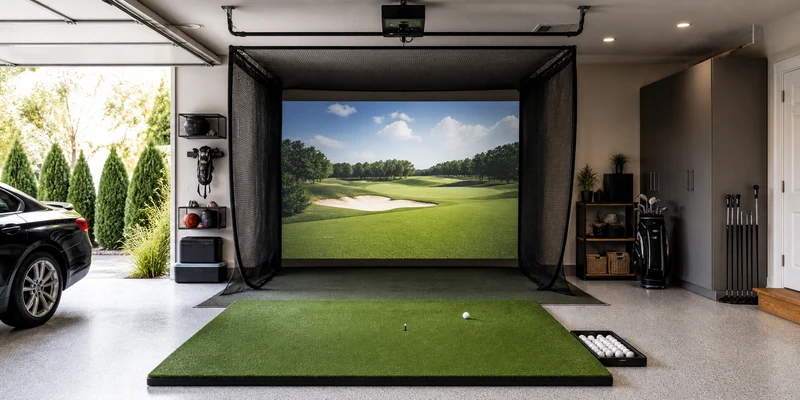
The garage is where most home simulators actually get built, and a garage golf simulator has real advantages over any other room in the house: concrete floors that do not care about spilled range balls, ceilings that are often taller than the living space, and a door you can open for ventilation or even hit through toward a backyard net. It is also the room with the most compromises to manage, because the car, the freezer, and the bikes were there first.
This guide covers the garage-specific decisions: how to check whether your bay has the height and depth for a full swing, which setups coexist with a parked car, what winter practice does to your gear choices, and which components hold up on a concrete floor. The picks lean on manufacturer specifications and consistent owner feedback rather than any testing of our own.
This article contains affiliate links. If you buy through them, we may earn a commission at no extra cost to you. Learn more.
Quick Answer
What is the best golf simulator setup for a garage?
- For most garages, a Garmin Approach R10 with a sturdy net and a thick hitting mat is the proven formula: full-swing practice in one bay, packed away in minutes when the car comes home.
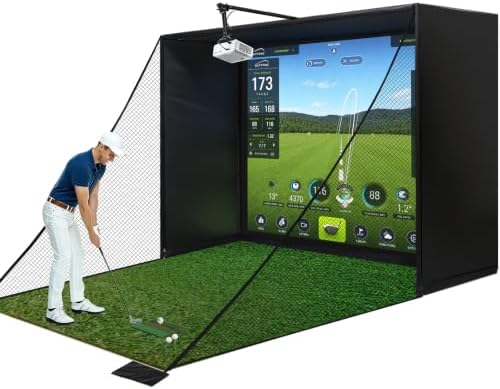
- If the garage is dedicated space, a complete enclosure package with an impact screen and projector turns the bay into a true simulator studio.
- Before buying anything, confirm the swing test: most golfers need roughly 9 to 10 ft of ceiling, plus enough width and depth to swing your longest club freely.
Garage Checks Before You Spend Anything
Run down this table with a tape measure and your driver before opening a single product page. Every item is verifiable in ten minutes.
| Check | Why it matters | What to look for |
|---|---|---|
| Ceiling height | The single most common dealbreaker | Most golfers need roughly 9 to 10 ft; take slow practice swings with your driver where the mat will sit, including under the garage door track |
| Door tracks and openers | Rails and motors hang below the ceiling line | Position the hitting area clear of tracks, chains, and the opener unit, or plan the bay so you swing parallel to them |
| Depth of the bay | Radar monitors sit behind the ball and need flight space in front | Check the listed space requirements of your launch monitor; camera units are generally the better fit in short bays |
| Floor | Bare concrete is hard on joints, clubs, and bounced balls | A thick hitting mat at the strike zone, ideally with rubber or foam tiles around it |
| Power and light | Projectors, monitors, and heaters all want outlets | At least one grounded outlet near the screen wall; even, indirect lighting helps camera-based monitors read the ball |
| Climate | Garages swing hot and cold with the seasons | Check the operating temperature range in your monitor’s documentation and plan a safe heat source for winter sessions |
If any measurement is marginal, the full walkthrough in our room dimensions guide shows how to judge edge cases before you commit.
Sharing the Garage With a Car
The honest answer to the car question: it depends on whether you can leave the hitting area standing. A net-based setup wins here, because a quality practice net folds or rolls to the wall in a few minutes, the mat slides flat against a shelf, and the launch monitor goes back in its case. Owners of this style of setup consistently mention that they practice more often precisely because nothing blocks the parking spot.
A full enclosure with an impact screen is a different commitment. Once the frame is up, the bay is a golf room, and the car lives outside or in the other bay. Some golfers split the difference with a screen on a retractable or quick-release mounting so the bay converts in minutes rather than hours. If the net route sounds like your garage, the dedicated garage golf net guide compares the options in depth.
Our Top Garage Setup Picks
How we chose: we compared garage-friendly components on space efficiency, setup and teardown speed, durability on concrete, and how consistently owners report them holding up to daily practice. Specifications and owner feedback patterns drive these picks, not in-house testing.
🏆 Best Overall
A portable radar launch monitor that suits the garage lifestyle: it sets up on a tripod behind the ball, pairs with a phone or tablet, and moves outside in summer. Note that full virtual course play requires a Garmin Golf membership tier, while range practice modes work without one.

💛 Best Value
A sturdy freestanding practice net sized for a garage bay, quick to fold away when the car returns. Reviews consistently mention the frame quality relative to its class. Position it with clearance behind, since no net catches every wild miss.

🧰 Best for a Dedicated Bay
A complete enclosure package with impact screen, frame, and side netting that converts one garage bay into a simulator studio. Add your launch monitor and a projector. Measure the bay against the listed frame dimensions, including the garage door hardware, before ordering.
Winter Practice: The Real Reason Garages Win
Ask garage simulator owners why they built the setup and the season answers for them: the garage is where golf survives the winter. Cold changes a few things worth planning for. Check the operating temperature range in your launch monitor’s documentation, since electronics and batteries have listed limits, and let gear warm up before a session rather than swinging in a freezing bay with stiff muscles.
For heat, follow the manufacturer’s safety instructions for whatever heater you use, keep it well away from nets, screens, and anything that swings, and ventilate; a cracked garage door for a few minutes between sessions does a lot. Mats also firm up in the cold, which is another argument for a thicker, better-cushioned mat in a garage than you might choose indoors.
Flooring, Mats, and the Concrete Problem
Concrete is the garage’s gift and its curse: indestructible, but unforgiving. The hitting mat is where you fix that, and it is the one component your body touches on every swing. Thicker mats with real turf layers are consistently reported to be easier on wrists and elbows during long sessions, and they protect club soles from the slab underneath. Our simulator mat guide ranks the options.
Around the mat, many garage builds add interlocking rubber or foam tiles, or a strip of landing turf, so bounced and rolled balls stay quiet and the standing area is warmer underfoot. If you are going the full-studio route, the turf and flooring guide covers wall-to-wall options that make the bay feel like a real practice room.
⛳ Best Mat for Concrete Floors
A thick multi-layer hitting mat sized for full swings, with enough cushion to take iron strikes off a concrete slab day after day. Owners consistently mention durability at this size and class as the reason it beats thin economy mats.

🎯 Best Screen Upgrade for a Shared Bay
An impact screen that hangs from a simple frame or quick-release mounting so a shared bay can convert to a simulator evening in minutes. Confirm it is rated for real golf balls and leave the recommended gap behind the screen to the garage wall.

Common Mistakes to Avoid
- Measuring the ceiling but not the door hardware. Tracks, springs, and the opener motor hang below ceiling height exactly where drivers swing. Test your swing under them, slowly, before buying.
- Buying a radar monitor for a short single bay. Radar units want depth behind and in front of the ball. In a compact garage, camera-based tracking is generally the safer choice; check the listed space requirements either way.
- Hitting off bare concrete with a thin mat. Joints and club soles pay for this within weeks. The mat is the wrong place to save.
- Trusting a net against a window or the car. Nets handle normal use, not every shank and toe-hook. Angle the setup so misses fly toward a wall, and add side netting in tight bays.
- Forgetting the software line item. Course play on most platforms means a membership or license on top of the hardware. Price it into the build from the start.
Where to Go From Here
If you are still choosing the brain of the setup, the launch monitor guide compares radar and camera units for exactly this kind of space, and launch monitor numbers explained makes sense of the data you are about to collect. For the bigger picture across every room and budget, the best golf simulator for home hub puts the garage option next to basements, sheds, and man caves. And if the bay could use some style along with the screen, the simulator room ideas article shows what finished builds look like.
Frequently Asked Questions
Can you fit a golf simulator in a single-car garage? Often, yes. The deciding factors are ceiling height, roughly 9 to 10 ft for most golfers, and enough width to swing freely. Short bays favor camera-based launch monitors and compact net setups over deep enclosures.
Do I have to remove the garage door opener? Usually not. Most golfers position the hitting area so the swing stays clear of tracks and the opener, or orient the setup to hit across the bay. Test with slow swings before committing to a layout.
Is a garage too cold or hot for a launch monitor? Electronics have listed operating ranges, so check your unit’s documentation. Many owners store the monitor indoors and bring it out per session in extreme months.
Net or impact screen for a garage? A net if the car still parks there, a screen and enclosure if the bay is dedicated. The net route is covered in our garage golf net guide.
What goes on the floor? A thick hitting mat at minimum, ideally with rubber tiles or landing turf around it. Bare concrete is hard on your body, your clubs, and your downstairs neighbors’ ears if the garage sits under living space.
The Bottom Line
A garage golf simulator is the most practical home build for most golfers: a Garmin Approach R10, a solid net, and a thick mat if the car shares the space, or a full enclosure package if the bay is yours alone. Verify ceiling height and swing clearance first, plan for winter temperatures, and never save money on the mat.