Last updated: August 10, 2026
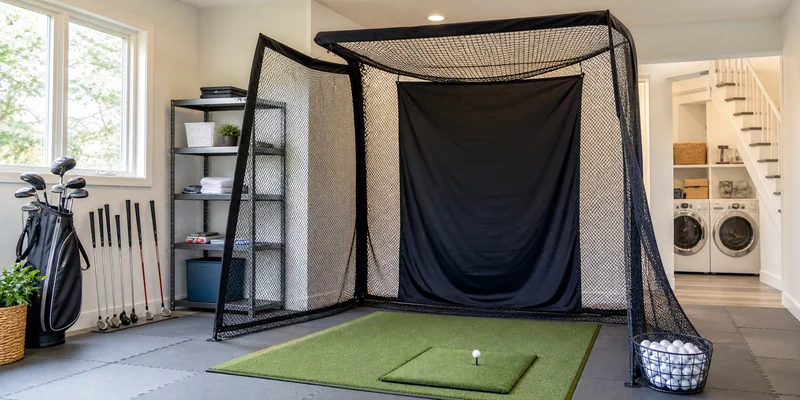
A golf simulator net is the honest budget answer to the enclosure question: you want to hit real balls indoors, you have a launch monitor or plan to get one, and you do not need a projected fairway to enjoy the practice. A quality net catches your shots, a mat protects your joints, and the simulator lives on a screen or tablet beside you instead of in front of you.
This guide covers what makes a net simulator-worthy: catch net construction, frame stability, side barriers for the shots that do not go where intended, and the setup habits that keep a net bay safe. It then points to the nets that come up most often in home setups, from garage staples to net-return designs.
This article contains affiliate links. If you buy through them, we may earn a commission at no extra cost to you. Learn more.
Quick Answer
Which golf simulator net should you buy?
- Buy a purpose-built golf practice net in the 10 foot class with a heavy-duty catch surface, a stable frame, and ideally side barrier wings for mishits.
- Pair it with a quality mat and place the setup so windows, people, and anything fragile sit well away from the line of play.
- No net catches every possible mishit. Follow each listing’s space guidance, inspect the netting regularly, and treat containment as a system, not a single product.
What to Check Before You Buy
Net listings are a sea of similar-looking mesh. These are the differences that matter once real balls start flying.
| What to check | Why it matters | What to look for |
|---|---|---|
| Net rating | Real balls carry real energy | Explicit real-golf-ball rating and a dense, heavy-duty weave; light mesh suits foam balls only |
| Catch design | Determines bounce-back behavior | A loose, angled catch pocket that absorbs and drops balls rather than a taut trampoline surface |
| Frame stability | A net that walks or wobbles fails eventually | Wide base, quality poles or fiberglass rods, and included stakes or weight options |
| Size | Bigger targets forgive more | Around 10 feet wide in the popular class; taller and wider is safer for drivers indoors |
| Side barriers | Mishits go sideways more than anywhere | Wing extensions or separate barrier netting flanking the main net |
| Setup and teardown | Shared spaces need fast transitions | Pop-up designs for speed, pole frames for permanence; know which room you are building |
If you are choosing between a net and a full screen setup, the difference is the projected image: our enclosure guide covers the screen route, and the broader net category beyond simulators lives in the golf hitting net guide.
Net or Impact Screen: The Real Trade-Off
The net route costs a fraction of an enclosure and asks less of the room: no projector, no throw distance math, no light control. Your launch monitor still measures every shot, and simulator software runs happily on a laptop, tablet, or TV to the side. For pure practice volume per dollar, nets win, which is why many golfers start here and upgrade later.
What you give up is immersion and a straight-ahead view of the ball flight. Watching a rendered fairway on a side screen after hitting into a net feels different from watching your ball vanish into a projected landscape. There is no wrong answer, only a budget and a room; plenty of net setups eventually grow into full bays, and the mat, monitor, and software all carry over. The full upgrade path is mapped in our best golf simulator for home guide.
Our Top Net Picks for Simulator Setups
How we chose: we compared widely available golf nets on netting weight, catch design, frame stability, and how consistently owners report them absorbing real-ball sessions without sag or breakthrough. Selections lean on manufacturer specifications and recurring themes in customer reviews rather than any hands-on trial of our own.
Every pick below is rated for real golf balls when assembled and spaced according to its instructions.
🏆 Best Overall
A 10 foot class practice net with a heavy-duty catch surface and a stable frame, the recurring garage favorite. Reviews consistently mention easy assembly and confident ball absorption at full swing speed.

💛 Best Value
A budget-friendly net with a generous catch area that covers a starter setup honestly, the common pick when the launch monitor consumed the budget.

⭐ Upgrade Pick
A net-return style design that funnels balls back toward the hitting area, cutting the pickup shuffle out of high-volume sessions and sparing the mat-side crouching.

Complete the Containment: Side Barriers and Bundles
The main net handles the shots you meant to hit. These two picks handle everything else.
🛡️ Best Side Protection
Barrier netting panels that flank the main net to catch heel and toe mishits, the single most recommended addition for indoor net bays with walls, windows, or storage nearby.

📦 Best Net-and-Mat Bundle
A matched net and hitting mat package for one-order starter setups, sized to work together out of the box.

Placement, Safety, and Net Care
Place the net so its center lines up with your natural ball flight, then walk the room imagining the bad shot, not the good one: thin shots fly low and hard, toe hooks go sharply left for a right-hander, and skulled wedges climb fast. Keep people and pets out of the room while hitting, angle the setup away from windows, and give the net the clearance behind and beside it that the listing asks for. A net stops what it catches; your layout decides what it gets the chance to catch.
Nets age in silence, which is why inspection matters. Check tension points, seams, and the center strike zone monthly, retire netting that shows fraying or stretched holes, and store fold-up designs dry rather than damp. Owners report that rotating the aim point slightly, exactly as with an impact screen, spreads wear and adds seasons of life. The wider safety picture for netted practice, including outdoor spacing, is covered in our net safety and space guide.
Common Mistakes to Avoid
- Hitting real balls into a foam-ball net. The rating line in the listing is not marketing filler. Light mesh nets fail exactly once at full speed.
- Trusting the net with the whole room. Side mishits are the most common miss indoors. Barrier wings or side netting are cheap compared with anything they save.
- Setting up tight against a wall. Nets deflect and flex backward on impact. Leave the clearance the manufacturer specifies behind the catch surface.
- Skipping the anchor step. An unanchored frame creeps backward and eventually tips. Stakes outdoors, weights indoors, always.
- Never inspecting the strike zone. Netting wears where you aim. A five-second monthly look at the center panel prevents the one surprise nobody wants.
Where to Go From Here
A net bay is two-thirds of a simulator: add a mat from our simulator mat guide and you are hitting today. If garage practice is the plan, the garage golf net guide handles that room’s quirks. When the upgrade itch arrives, the enclosure guide shows the screen route, and best golf simulator for home maps the complete build.
Frequently Asked Questions
Can I use a golf net instead of an impact screen for a simulator? Yes. The launch monitor does the measuring either way; the net just catches the ball while the simulation runs on a side display. You trade the projected fairway for a much smaller budget and simpler room requirements.
Are golf nets safe to use indoors with real balls? With a net rated for real balls, correct assembly, honest clearances, and side protection for mishits, indoor net practice is how thousands of golfers train. No net catches every conceivable shot, so layout and habits carry part of the job.
How much space do I need behind a golf net? Enough for the net to flex fully without touching anything, per the listing’s guidance. Crowding a net against a wall makes it louder, bouncier, and shorter-lived.
What size net should I buy? The 10 foot wide class is the practical standard for full swings. Bigger is genuinely better indoors, because the net’s job is to be impossible to miss on your worst swing, not your best.
Do net-return designs work? Owners report they work well for the shots that hit the catch zone cleanly, which is most of them. Expect to still collect the occasional ball manually; the feature saves effort rather than eliminating it.
The Bottom Line
The best golf simulator net is a real-ball-rated, 10 foot class net with a stable frame, an absorbing catch design, and side barriers doing the quiet safety work. Pair it with a good mat, respect the clearances, and inspect the strike zone monthly. It is the budget door into home golf, and for many golfers it never needs upgrading.