Last updated: August 10, 2026
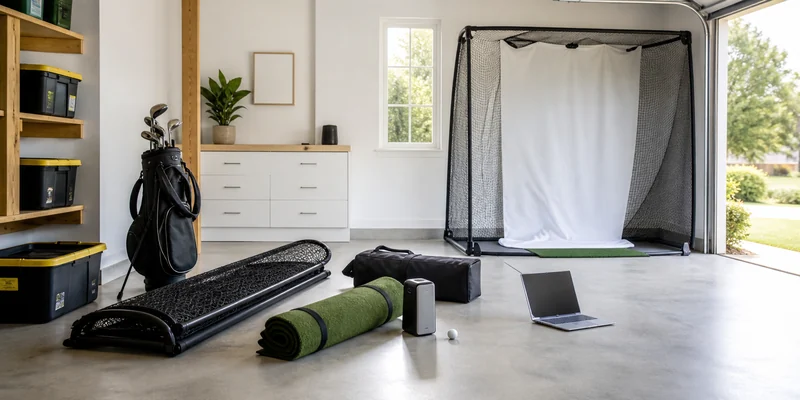
A portable golf simulator answers the question most simulator content politely ignores: what if you cannot give golf a permanent room? Renters, families sharing a living space, and golfers whose garage is genuinely full still want winter practice. The portable formula solves it with three pieces that set up in minutes and disappear into a closet: a compact launch monitor, a foldable net, and a mat that rolls or folds flat.
The market has never been friendlier to this approach. Launch monitors have shrunk to camera-bag size, pop-up nets have become genuinely sturdy, and simulator software runs on the phone already in your pocket. This guide sorts the options by how they pack away, what they give up against a fixed studio, and which combinations owners consistently rate as worth the closet space. Everything here rests on specifications and owner feedback patterns, not our own testing.
This article contains affiliate links. If you buy through them, we may earn a commission at no extra cost to you. Learn more.
Quick Answer
What is the best portable golf simulator setup?
- The strongest portable core is a Garmin Approach R10 with a foldable net and roll-up mat: real ball data, phone or tablet display, and a five-minute setup that stores flat.
- For the smallest budget, an OptiShot package plus a laptop is a simulator in a duffel bag, with club-based tracking as the honest trade-off.
- Portability changes the room math, not the physics: you still need full swing clearance wherever the net goes up, roughly 9 to 10 ft of ceiling indoors for most golfers.
What Portable Really Means: The Comparison
Portable covers everything from a monitor that rides in your golf bag to a net that merely folds. This table splits the claim into what you can actually verify on a listing.
| Component | Portable version | What to check on the listing |
|---|---|---|
| Launch monitor | Compact radar or camera unit with tripod or stand, battery powered | Battery runtime, listed placement distance, and which app features need a subscription tier |
| Net | Pop-up or folding frame that one person can raise | Honest setup time, packed dimensions, and the frame mechanism owners say survives repeated cycles |
| Mat | Roll-up or folding hitting surface | Whether it lies flat again after storage; thin travel mats are harder on wrists during long sessions |
| Display | Phone, tablet, or laptop instead of projector | Which devices the monitor’s app supports; casting to a TV is the popular middle ground |
| Software | App-based range and course play | Course play often sits behind a membership, license, or plan; range modes usually do not |
Wherever the setup goes up, indoors it still needs the same clearance as a fixed bay; the numbers and edge cases are in our room dimensions guide.
The Portable Trade-Offs, Honestly
What you give up against a fixed studio is mostly immersion and ritual: no projected fairway filling a wall, no permanently dialed-in monitor position, and a few minutes of setup before every session. Data quality does not have to suffer, because the same launch monitor sells in both worlds, but consistency of placement does; radar units especially reward marking your floor positions with tape so the geometry repeats between sessions.
What you gain is usage. Owners of packable setups consistently report practicing more than they expected, because the gear moves to where life happens: living room in January, backyard in June, a friend’s garage on the weekend. A portable core also derisks the hobby, since every piece carries over if you later commit to a permanent room from the full home simulator guide.
Our Top Portable Picks
How we chose: we compared packable setups on setup speed, packed size, data quality for the class, and how consistently owners report the folding mechanisms and electronics surviving repeated moves. Specifications and owner feedback patterns drive these picks, not in-house trials.
🏆 Best Overall
A camera-bag-sized radar launch monitor that runs on battery, mounts on a small tripod, and pairs with the phone you already own. It is the portable simulator core by a wide margin in owner mentions. Range practice works on the free app; full course play needs a Garmin Golf membership tier.

💛 Best Value
A sensor-mat simulator that packs into a duffel with a laptop and plays included courses anywhere with a power outlet. Club-based tracking rather than ball flight, so treat numbers as feedback, but no portable option costs less to get playing.

⛳ Best Portable Net
A folding practice net that one person raises in a couple of minutes and collapses flat for a closet or car trunk. Reviews consistently mention frame durability through repeated setup cycles, the spec that actually matters in this class. Position it with clearance; no net catches every miss.
Building Out the Kit: Mat, Enclosure, and the Car Trunk Test
The mat is the sneaky-important piece of a portable kit, because thin roll-up mats trade your joints for convenience. Look for a travel mat with genuine cushion that still lies flat after storage, and give it the car trunk test on paper: packed size and weight are on every listing. For choosing among the wider field of nets and mats, our hitting net guide ranks the options across budgets.
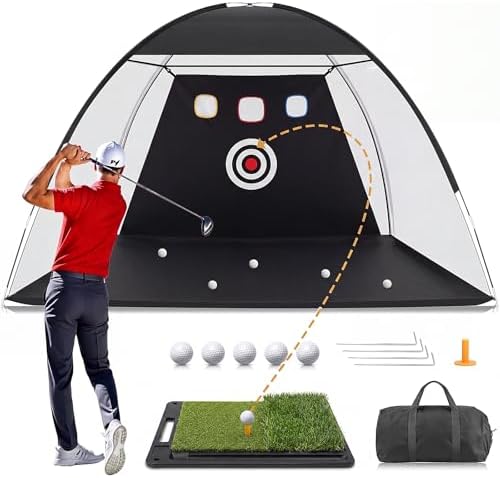
If you want more immersion than a bare net without surrendering the room, pop-up enclosures split the difference: side barriers and a screen-like backdrop that still tear down in minutes. They reward careful measuring, since packed-away gear that never fits the room never comes out of the closet again.
🧰 Best Pop-Up Enclosure
A foldable enclosure with side netting that frames the hitting area like a studio but breaks down for storage. A practical upgrade once the bare-net phase proves the habit sticks; check packed dimensions against your storage space first.

🎯 Best Travel Mat
A cushioned hitting mat sized for full swings that rolls or folds without taking a permanent wave. Owners consistently mention flatness after storage as what separates the keepers from the returns in this category.

Common Mistakes to Avoid
- Assuming portable means clearance-free. The swing needs the same room wherever the net pops up: roughly 9 to 10 ft of ceiling indoors for most golfers, plus width. Measure the living room before trusting it.
- Rebuilding the geometry from scratch every session. Radar monitors want consistent placement behind the ball. Tape marks on the floor turn five minutes of fiddling into thirty seconds.
- Buying the thinnest possible mat. Packability is worthless if wrists ache after twenty balls. Cushion first, packed size second.
- Ignoring battery and app requirements. Portable sessions run on batteries and phone apps; check runtime claims and which features sit behind a subscription tier before relying on either.
- Skipping the safety walk-around. A net that moves between rooms never gets the fixed-bay safety check. Each setup, confirm clearance behind the net and keep people and glass out of the miss zone.
Where to Go From Here
If the launch monitor is the piece you are still weighing, the launch monitor guide compares portable-friendly units in depth, and launch monitor numbers explained makes the resulting data useful. Working with a hard spending ceiling? The budget simulator guide builds complete starter setups, and when a permanent room eventually opens up, the home simulator hub shows what your portable core grows into.
Frequently Asked Questions
Is a portable golf simulator worth it? For renters and shared-space golfers, it is often the only realistic option, and the core pieces carry over to a permanent build later. Owners consistently report using packable setups more than they expected.
What do I need for a portable setup? A compact launch monitor, a folding net, a roll-up mat, and a phone or laptop for display. Everything should pack to closet size; check packed dimensions on each listing.
Do portable launch monitors need a subscription? The main ones gate features differently: Garmin’s full course play needs a membership tier while range modes are free, and other platforms use licenses or plans. Confirm before buying around a specific feature.
Can I use a portable simulator outdoors? Yes, and radar units are generally reported to be at their best with outdoor ball flight to track. Mind wind with lightweight nets and stake or weight anything that could tip.
How much space does it need indoors? The same as any simulator swing: roughly 9 to 10 ft of ceiling for most golfers and free width for your longest club. Our room dimensions guide covers the details.
The Bottom Line
A portable golf simulator is a Garmin Approach R10, a folding net, and a decent travel mat: real practice that lives in a closet and moves with the seasons. Accept the immersion trade-off, tape your floor positions, and never buy a mat thinner than your wrists can afford. It is the lowest-risk entry into home golf there is.