Last updated: August 10, 2026
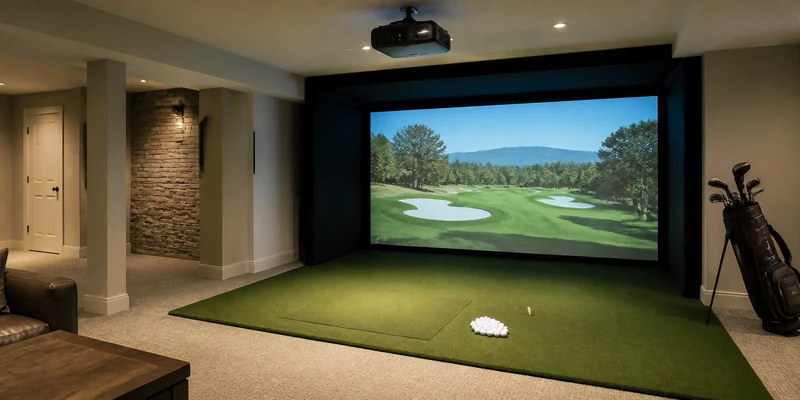
A basement golf simulator lives or dies on one measurement, and it is not floor space. Basements usually have plenty of depth and width for a hitting bay; what they rarely have is generous ceiling height, and the ducts, joists, and pipes that cross a typical basement ceiling all steal inches exactly where a driver swings. The golfers who love their basement setups are the ones who solved the height question honestly before buying anything.
Get past that gate and the basement is arguably the best simulator room in the house: climate-stable year-round, private, quiet for the neighborhood, and available at ten in the evening in February. This guide covers how to judge your ceiling, which gear suits low and dim rooms, and how to keep the peace with the floor above, all based on manufacturer specifications and consistent owner feedback rather than our own testing.
This article contains affiliate links. If you buy through them, we may earn a commission at no extra cost to you. Learn more.
Quick Answer
Can you put a golf simulator in a basement?
- Yes, if the ceiling clears your swing: most golfers need roughly 9 to 10 ft for a driver, and many basements fall short of that, so test slow swings under the lowest obstruction first.
- If the ceiling is marginal, build the setup around irons and wedges; plenty of owners practice happily this way and hit driver outdoors.
- The proven basement formula is a launch monitor suited to indoor use, an impact screen or net, a thick mat, and deliberate lighting, since basements are dim by default.
Basement Checks Before You Buy
Every row in this table is a check you can run tonight with a tape measure and a club. The ceiling rows matter most; the rest is comfort.
| Check | Why it matters | What to look for |
|---|---|---|
| Ceiling at the hitting spot | The decisive measurement | Roughly 9 to 10 ft for a full driver swing for most golfers; measure under the lowest duct or joist near the mat, not the open ceiling |
| Club strategy | Marginal ceilings can still work | Swing each club slowly at the planned spot; many basement setups are built around irons and wedges by design |
| Depth and layout | Monitor placement needs room | Check the listed space requirements of your launch monitor; radar units sit behind the ball and want flight space in front |
| Lighting | Basements are dim, cameras care | Even, indirect lighting at the hitting area helps camera-based tracking and makes the projector image pop instead of wash out |
| Moisture | Screens, mats, and electronics dislike damp | A dry basement or a dehumidifier; check humidity guidance in your gear’s documentation |
| Sound upstairs | Impact is percussive | Ball strikes and screen thumps carry through the structure; placement away from bedrooms and some padding go a long way |
The honest edge cases, low beams, sloped ceilings, and what still works under them, are covered in our room dimensions guide.
The Low Ceiling Playbook
If your basement misses the comfortable driver number, you have three respectable options before giving up. First, move the hitting spot: ceilings are rarely uniform, and shifting the mat a few feet away from ductwork sometimes finds the clearance a swing needs. Second, commit to an iron-and-wedge setup: scoring clubs swing on a flatter, shorter arc, and a practice diet built on them is a legitimate way to use a simulator, not a consolation prize.
Third, adjust expectations by player: smaller golfers and flatter swings clear lower ceilings, so the only test that counts is your own club, your own swing, swung slowly under the real obstruction. What you should not do is buy first and hope; a cracked light fixture or a scarred joist is the traditional basement souvenir of that approach.
Our Top Basement Picks
How we chose: we compared setups on indoor tracking behavior, tolerance for dim rooms, footprint, and how consistently owners report reliable performance in basement conditions. Specifications and recurring owner feedback drive the picks, not in-house trials.
🏆 Best Overall
A portable radar launch monitor that anchors a serious basement bay, provided the room offers the listed placement depth behind the ball. Pairs with a phone, tablet, or projector screen; full virtual course play sits behind a Garmin Golf membership tier, while range modes work without it.

💛 Best Value
An infrared sensor mat simulator that reads the club through impact, which makes it notably indifferent to basement lighting. Tracking is club-based rather than ball-based, so treat the data as practice feedback, but it turns a dim basement into a playable course for the least money.

🧰 Best for a Finished Studio
A complete enclosure package with impact screen and side barriers that turns one basement wall into the business end of a simulator. Verify the frame height against your true ceiling clearance, including ducts, before ordering.

Light, Sound, and the Floor Above
Basement light is the quiet variable in setup quality. Camera-based monitors are generally reported to track best with even, indirect light on the ball, and every projector image looks better when stray light is controlled rather than absent. Aim for consistent lighting at the hitting area, no fixtures in the swing path, and nothing shining at the screen. The lighting and wall padding guide covers layouts that work.
Sound is the other courtesy problem. A golf strike is sharp, and an impact screen turns it into a low thump that travels through joists into the living room above. Owners manage it with padding behind and around the screen, a dense mat underfoot, and honest scheduling; midnight driver sessions under a nursery are how simulators get banned. If your household is noise-sensitive, a net catches balls more quietly than a taut screen.
⛳ Best Mat for Concrete Floors
A thick multi-layer hitting mat with real cushion between your joints and the slab, which matters double in a basement where every session happens on concrete. Owners consistently mention comfort over long sessions as the reason to size up in quality here.

🎯 Best Quiet-Room Alternative
A freestanding practice net for basements where a taut impact screen would be too loud for the floor above. Sets up and folds away fast, and position it with clearance, since no net catches absolutely every miss.

Common Mistakes to Avoid
- Measuring the open ceiling instead of the lowest duct. The swing happens under whatever hangs lowest near the mat. That is the number that decides the build.
- Buying driver-first for a wedge-height room. If the ceiling is marginal, design the setup around irons on purpose instead of flinching every swing.
- Ignoring lighting until after the build. Dim basements frustrate camera tracking and flatten the projected image. Plan lights with the layout, not after it.
- Setting the screen hard against a wall. Impact screens need their listed clearance behind them to absorb shots quietly and survive. Check it before fixing the frame position.
- Forgetting the people upstairs. Thump transmission through joists is real. Padding, a dense mat, and reasonable hours keep the simulator a family amenity instead of a grievance.
Where to Go From Here
If the launch monitor question is still open, the launch monitor guide weighs camera against radar for enclosed rooms, and launch monitor numbers explained is the primer for the data you are about to generate. To see the basement option next to garages, sheds, and man caves, the best golf simulator for home hub has the full map, and the room ideas article shows how finished basement builds look when the cables are hidden and the walls are dark.
Frequently Asked Questions
How much ceiling height does a basement simulator need? Most golfers need roughly 9 to 10 ft for a comfortable driver swing. Lower ceilings can still host iron-and-wedge setups; the deciding test is your own slow swing under the lowest obstruction.
Is a basement too dark for a launch monitor? Camera-based units are generally reported to want even lighting on the ball, so plan fixtures at the hitting area. Infrared systems like OptiShot and radar units are less sensitive to room light.
Will a basement simulator be loud upstairs? Ball strikes and screen impacts do carry through the structure. Padding around the screen, a dense mat, and placement away from bedrooms reduce it substantially; a net is quieter than a taut screen.
Do I need to worry about basement moisture? Yes, for screens, mats, and electronics alike. A dry basement or a dehumidifier protects the investment; check the humidity and storage guidance in your gear’s documentation.
Can I play full simulated rounds in a basement? Yes, with a monitor and software combination that supports course play. Note the subscription reality: Garmin course modes need a membership tier, GSPro needs a license, and E6 Connect uses tiered plans.
The Bottom Line
A basement golf simulator starts with one honest measurement under the lowest duct, and everything else follows. Clear roughly 9 to 10 ft and any setup works; fall short and a deliberate iron-and-wedge build still earns its keep. Solve lighting, respect the floor above, and the basement becomes the most-used room in the house.