Last updated: August 10, 2026
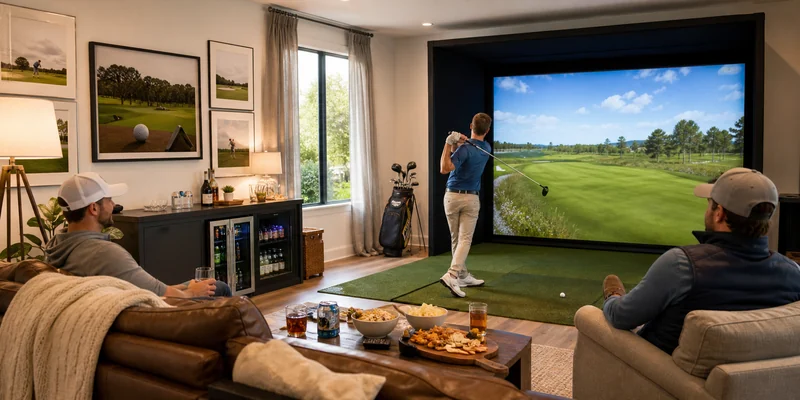
A golf simulator man cave is a different project from a practice bay. A practice bay is about reps; a man cave is about the evening, the projected fairway glowing on a screen, friends on the couch arguing over a closest-to-the-pin game, and a room that feels deliberately built rather than assembled. The gear list overlaps with any home simulator, but the priorities shift toward immersion, comfort, and software that entertains a group.
This guide covers the man cave version of every decision: the screen-and-projector combination that creates the atmosphere, the launch monitor that keeps a group game moving, the layout that lets spectators exist safely in the same room as a driver swing, and the finishing layers of light and sound. Recommendations rest on manufacturer specifications and consistent owner feedback, not on hands-on testing of our own.
This article contains affiliate links. If you buy through them, we may earn a commission at no extra cost to you. Learn more.
Quick Answer
What makes a great golf simulator man cave?
- Build around immersion: an impact screen with a short throw projector beats a net and tablet for atmosphere, and it is what turns practice into an evening.
- Choose software with group play in mind; multiplayer modes and party games matter as much as course lists, and check which features need a membership or license.
- Plan the room in zones: a hitting zone with full swing clearance, a spectator zone safely behind the hitting line, and the couch, fridge, and putting corner around them.
The Man Cave Build Sheet
Six decisions define the room. The first two are physics, the rest are taste with guardrails.
| Decision | Why it matters | What to look for |
|---|---|---|
| Swing clearance | Physics before decor | Most golfers need roughly 9 to 10 ft of ceiling and free width for a driver; verify with slow swings before furniture is planned |
| Spectator safety | Groups and golf swings share the room | Seating fully behind the hitting line, never beside the player; side netting if the room is tight |
| Screen and projector | The immersion engine | A real-ball-rated impact screen and a short throw projector mounted overhead so nobody casts a shadow on the fairway |
| Launch monitor | Keeps group play moving | Fast shot-to-shot readiness and easy player switching; check placement requirements against the layout |
| Software | The entertainment layer | Multiplayer rounds, skills games, and party modes; confirm which sit behind a Garmin membership tier, GSPro license, or E6 Connect plan |
| Light and sound | The atmosphere layer | Dimmable, indirect light that spares the screen, plus speakers; padding doubles as acoustic treatment |
If the room is not yet chosen, the room dimensions guide settles which basement, garage, or bonus room can actually host the swing before you fall in love with a floor plan.
Immersion: Screen, Projector, and the Dark Room Advantage
The difference between a setup and a man cave is mostly light management. A projected course in a controlled-light room with dark walls reads like a window onto a fairway; the same projector fighting daylight looks like a faded poster. This is why man caves gravitate to basements and windowless bonus rooms, and why wall color and dimmable fixtures belong on the gear list next to the screen.
The hardware pairing is straightforward: an impact screen sized to the room and a short throw projector mounted to the ceiling, close to the screen, so the image clears the player and no shadow falls across the shot. Throw ratio, mounting position, and screen choice are covered in depth in our simulator projector guide and impact screen guide; get those two right and the atmosphere mostly builds itself.
Our Top Man Cave Picks
How we chose: we compared components on immersion value, group-play friendliness, and how consistently owners report them performing in finished dedicated rooms. Picks lean on specifications and recurring owner feedback rather than in-house trials.
🏆 Best Overall
A complete enclosure package with impact screen, frame, side barriers, and mat: the entire hitting end of the man cave in one coordinated purchase, ready for your projector and monitor. Confirm the listed dimensions against ceiling and wall measurements before ordering.

⭐ Upgrade Pick
A premium camera-based launch monitor with simulator software and a built-in display, which cuts the laptop clutter out of a finished room. Reviews consistently mention how quickly it moves between players, exactly what group evenings need. Check which course features require Garmin’s membership tier.

🎯 Best Projector
A short throw projector bright enough for a golf screen and designed to throw a large image from close range. Mounted overhead, it keeps the fairway free of shadows; match the throw ratio to your screen distance before buying.

Software for Groups: The Party Layer
Solo practice software and group entertainment software overlap but are not the same purchase. For an evening with friends, you want fast player switching, scoring the room can see, and game modes shorter than eighteen holes: closest-to-the-pin contests, long drive, and skills challenges keep non-golfers involved. Platform support differs by launch monitor, and the paid layers differ too: Garmin’s full course play sits behind its membership tier, GSPro uses a license, and E6 Connect runs tiered plans. The full landscape is mapped in our simulator software guide.
Budget group setups deserve a mention here, because the cheapest route to multiplayer golf in a man cave is not a premium monitor at all.
💛 Best Value Party Setup
An infrared sensor-mat simulator with included courses and multiplayer rounds that friends can jump into with any club in the bag. Club-based tracking is not tour-grade data, but for a social room it delivers the most laughs per dollar of anything in the category.

⛳ Best Corner Add-On
An indoor putting mat for the non-hitting corner of the room, which keeps a second guest playing while the screen is occupied. Owners consistently mention the putting corner as the most-used square footage after the bay itself.

Layout, Seating, and Keeping Guests Intact
Design the room like a small driving range with a lounge attached, in that order. The hitting zone gets its clearance first: full swing room to the ceiling and sides, the monitor at its listed placement, and the screen with its recommended gap to the wall. Only then does furniture enter, and always behind the hitting line, where a toed drive cannot reach. In narrow rooms, side netting between bay and seating is cheap insurance, and the lighting and padding guide covers the protective layers that double as acoustic treatment.
The lounge half is where the room earns the name: comfortable seating with a clear view of the screen, a surface for drinks well away from electronics, and light zones you can dim separately from the bay. None of it needs golf branding to work; it needs the same logic as a small home theater that happens to contain a fairway.
Common Mistakes to Avoid
- Furnishing before verifying the swing. The couch is easy; the 9 to 10 ft of ceiling clearance most golfers need is not. Physics first, decor second.
- Seating beside the hitting zone. Spectators belong fully behind the hitting line. A mishit travels sideways more often than new builders expect.
- Buying a standard throw projector for a short room. It will either sit in the swing path or project the player’s shadow onto the course. Short throw, ceiling mounted, close to the screen.
- Ignoring the subscription layer of group software. The party modes that sell the room may sit behind a membership or license. Confirm what the hardware includes before the first game night.
- Treating acoustics as an afterthought. A taut screen is loud and a hard room echoes. Wall padding, rugs in the lounge zone, and a dense mat tame it cheaply.
Where to Go From Here
For the full component hierarchy and how the man cave build compares to garage and basement setups, start at the best golf simulator for home hub. Visual inspiration, wall treatments, and finished-room examples live in the simulator room ideas article, and when you start reading your own shot data between rounds, launch monitor numbers explained translates it into plain English.
Frequently Asked Questions
How big does a golf simulator man cave need to be? Big enough for a full swing with clearance, roughly 9 to 10 ft of ceiling for most golfers, plus a spectator zone behind the hitting line. Depth depends on your monitor’s listed placement requirements.
What is the best layout for spectators? Seating directly behind the hitting area, never alongside it, with side netting in tight rooms. Everyone should watch the screen, not the clubhead, from their seat.
Do I need a projector, or is a TV enough? A TV works for data and casual practice, but it sits vulnerably near the swing and breaks immersion. An impact screen with a short throw projector is the man cave standard for good reason.
Which software is best for group play? The one your launch monitor supports that offers fast player switching and short game modes. Compare platforms in our software guide and note which features need a paid tier.
Can the room double as a home theater? Naturally. The same controlled light, projector, and seating serve movies between rounds; owners consistently mention this dual use as what sold the household on the build.
The Bottom Line
A golf simulator man cave is a home theater with a fairway where the screen should be: enclosure and impact screen first, short throw projector overhead, a monitor that keeps groups moving, and seating safely behind the line. Verify swing clearance before furniture, budget the software layer honestly, and let the dark room do the atmospheric heavy lifting.